Posts Tagged ‘justice’

Hark what’s that?

Saturday, December 14th, 2013

View just this post

angles-in-america-1024The golden moments in the stream of life rush past us and we see nothing but sand; the angels come to visit us, and we only know them when they are gone.  ~George Elliot


‘Tis the season for angels, angels, angels!  We sing songs about angels, read stories about angels, we make angels in the snow, and of course, we put angel images everywhere.  On cookies, in frames, frozen in sculpture, molded in chocolate, and then we even impale them on decorated trees.


Most of the angel images are of the sweet cherub variety – angels in the guise of small children.  And most of the angels disguised as humans I have met have been under the age of seven.  (of course I have met quite a few “devils” in this age group too)  These cute little angels are messengers that call us back to play and make believe.  They bring us tidings of unconditional love.  They break our hearts when they are sad or hurt because they love so purely.


Biblical angels are a different matter altogether.  When an angel shows up in a text, I often ask the congregation, “now what is the first thing an angel says?”  Folks then call out: “behold” or “lo”, but actually the first thing a Biblical angel usually says is “fear not”.  When the angels visit the shepherds on Christmas Eve, listen for this language about fear.


Fear not, indeed.  In Tony Kushner’s brilliant play, “Angels in America”, the angel, played by the brilliant Emma Thompson, is terrifying, enthralling, mysterious, and sexy.  The message of this angel is hard to decipher and can only be understood in the context of the struggle of Prior Walter to live and finally die with AIDS.  S/he (angels are usually depicted as being quite androgynous) appears in supernatural visions and then in the guise of a wise nurse, a homeless woman, and more enigmatically as a real estate agent.  The message of the voice/angel in this play is to tell Prior Walter that he is a prophet:  that his life has meaning and how he lives with this plague matters.  Prior, by conquering his fear of the angel (and God) will then be able to speak prophetic words of life in the midst of death.


I believe that angels – messengers of God – are hovering all about us.  This is not a particularly “woo woo” sort of belief, nor do I think that we are surrounded by all sorts of strange spiritual beings.  And I am particularly not interested in long discussions of fallen angels, angel armies, guardian angels, or the various hierarchies of angels in heaven and hell.  Instead, I believe that bits and pieces of divine wisdom are scattered within creation and that there is much we can learn if we are simply willing to listen.


God is still speaking through little children, furry four-leggeds, mountains, valleys, tragedies, triumphs, and through our sisters and brothers – any one of whom may suddenly become an angel to us bringing a message from the Divine.


‘Tis the season for angels – can you hear them sing? speak? And if you find yourself suddenly fearful, listen very, very carefully, for an angel may be on the way.


Mandela and the Power of Silence

Friday, December 6th, 2013

View just this post

void-of-silenceIn last Sunday’s sermon I “outed” myself as a mystic. Clearly not a FAMOUS mystic, but I do have mystical tendencies, value the teachings of Christian mystics (in particular) and I have embraced a number of spiritual practices that are often labeled “good for mystics”.


My journey with mysticism began when I was introduced to the great medieval Christian mystic Hildegard von Bingen. Hildegard’s life and writing, in particular, resonate with me because I also love her beautiful music.  Singing, chanting, and playing music from a place of spiritual contemplation is still my most beloved (and effective!) spiritual practice. Long before I knew anything about mysticism, I had already discovered that playing the piano was a way that I could experience the divine in an immediate and powerful way. In the throes of adolescence when I knew I was “different” or when things weren’t going well, the piano was my refuge.


In seminary, my spiritual director first challenged me to consider a silent retreat. This was no surprise since spiritual directors are pretty much honor bound to suggest these things. In addition, I’m pretty sure he thought that this might be a way to tame some of my extreme extroversion, too. Still, his invitation wasn’t really the thing that finally got me to go to a convent and to later crave silence and contemplative spiritual practice.


Sometime, somewhere in the early 90’s, I heard an interview with Nelson Mandela that changed my thinking completely about the importance of silence and contemplation. The interviewer asked Mandela how it was that he came to embrace forgiveness and reconciliation after all that had been done to him by the apartheid regimes. Mandela spoke of what it was like to spend so many years alone and in silence while he was in prison. He then told the interviewer that once he truly had seen his own soul in this way, he knew something about his own failings and need for forgiveness. And in the silence, trying to face up to his own failures and need for forgiveness, he became committed to the path of forgiveness and reconciliation for all peoples. The rest of that story, of course, is history that we are now remembering upon the occasion of Mandela’s death.


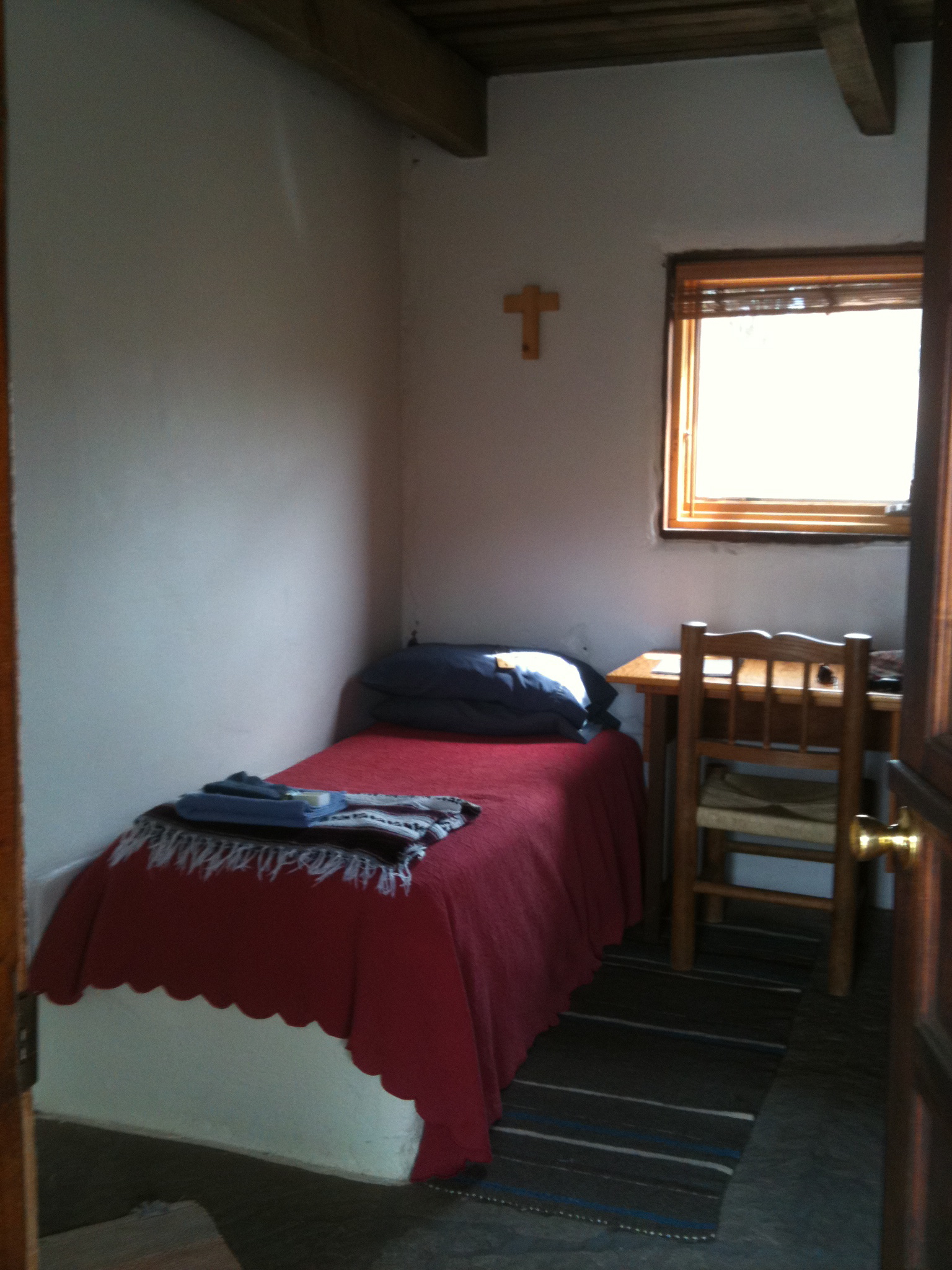
IMG_0346So without being arrested and hauled off to prison, I decided to follow Mandela’s spiritual path by voluntarily committing myself to at least a few days in a monastic cell. My first silent retreat was really hard. I chose to go to a Franciscan convent in the Santa Cruz mountains near Soquel, California called St. Clare’s Retreat.  While I was on a personal retreat, there was a large group from a Hispanic Roman Catholic parish in San Jose there at the same time. The young priest from Mexico who was leading their retreat spoke little English and so mealtimes were a multi-layered, multi-cultural experience for me. But the real difficulty came when I sat in my “cell” and was forced to listen to my own mind for hours on end.


In the stillness, I watched my own fears and insecurities rise up like demons. Every error, every mistake I had ever made haunted my every moment-by-moment decision-making about whether to read, walk around, or try to work on a sermon on Yael for my preaching class. The choice to bring Yael as a companion on a silent retreat was particularly bad. (and it didn’t produce one of my best sermons either)


During this first retreat, I discovered why so many monasteries have structured prayer times. It is very difficult to constantly choose for yourself how to spend your time in solitude. The bells that called us all to the chapel for prayer were a relief from having to confront your own inner craziness. This insight alone was life-changing for me. Feeling stressed, lonely, or sad? Lean on a structure that feeds your spirit. Plan times for meditation, walking, exercise, music practice and you’ll be less crazy. And there are so many potential spiritual practices – just about anything that you do in some regular way at a regular time can be of great comfort in times of distress.


IMG_0343Since that first retreat over twenty years ago, I have made time for silent retreat as often as possible and two years ago, I finally found the monastery that provides the perfect mix of spiritual practices for me.


Christ in the Desert is located about 45 minutes off the highway past Ghost Ranch in Northern New Mexico. The landscape alone brings me to awe. The community of monks follows a form of primitive Benedictine practice. They begin at 4:00 a.m. with the office of Vigils and they then pray the full monastic office.  In each of these offices, the monks chant the psalms, and if you go for a full week, you can chant all 150 psalms. The singing is acappella and based upon ancient psalm tones that are notated in such a way that significant training in music (or monasticism) is required in order to participate. Most folks simply listen to the monks, but I enjoy that my early music professor Dr. Anne Schnoebelen at Rice taught us to read this notation so I get to sing all day!


Chanting the psalms is another window into the breadth and depth of the human soul. While there are beautiful words of praise and thanksgiving, many psalms have large sections of violent pleadings for revenge asking God to “smite” the psalmist’s enemies. It is humbling to sing these texts and “put these words in your own mouth” because – in the silence – you come to understand that some part of your soul prays this way all the time. But just as you recognize your own internal violence, another psalm will call you to repentance and new life, and then back to praise and thanksgiving.


While contemplative spirituality does not appeal to everyone, it certainly is unfair to label such practices as “navel-gazing” or “self-serving”. In my own experience, these practices have been instrumental in helping me become more compassionate and forgiving of myself and of others.

 
And so today I will light a candle, chant the psalms, and give thanks for the life of Nelson Mandela who learned to change the world by first starting with his own soul. In silence.


Justice and Compassion

Friday, November 8th, 2013

View just this post

katrinaJustice is what love looks like in public – Dr. Cornel West

There is an old story told about a village on a river that I first heard from a nun friend, but it seems to be so old (and pervasive) that I could not find an origin. If anyone can name the source, I’ve got a lollypop with your name on it!

Once there was a village next to a river. On one fine afternoon, the villagers were shocked to discover the body of drowned man on the shorline. They hauled his body out of the water and gave him a proper burial. The next day they noticed an injured man floating in the river, so strong swimmers were dispatched to rescue him and bring him ashore where the villagers nursed him and cared for him, but he died too without being able to tell them how he wound up in the river. Soon the villagers were hauling men, women, children, and even babies out of the river. Most died, but a few lived for a little while.

In the midst of providing compassion for the victims that arrived at their village via the river, some of the villagers decided to go upstream to try to discover why so many people were winding up in the river. They soon discovered a group of bandits were robbing and beating travelers on a bridge and throwing their bodies into the river. The villagers that went upstream eventually were able to bring the bandits to justice and then there were no more victims washing ashore downstream.
This story is told as a simple way to understand the difference between compassion (downstream) work and justice (upstream) work. In my experience, most people gravitate strongly towards being upstream or downstream folks. Some people have done both over the years, but most orient one way or the other. It is also true that exercising compassion and justice is never so easy. Finding the root causes of hurt in the world rarely happens by simply taking a little hike. And caring for those who are struggling and injured and in need is a very big job too.
Of course, in a desperately hurting world, we need to be engaged in both compassion and justice because neither is adequate alone. Justice without compassion is uninformed and can be heartless. And compassion without justice is anemic and eventually futile. Unfortunately, those of us who orient mostly towards either side of the justice/compassion coin can often be quite judgmental towards those who are upstream or downstream of our own interests even though we may intellectually understand the value of both.
In my own life, I have certainly been engaged upstream for long periods of time and downstream at other times. I truly value both and also know that I am prone to burn out if I don’t do both at various times and/or seasons of my life. I also believe that it is exceptionally important for a community to make sure to make room for both and to be very clear about the differences in these activities. We can also celebrate that sometimes our activities can do both.
Less than a year after Hurricane Katrina hit the Gulf Coast and the massive public policy failure that is/was the levee system devastated New Orleans, I was honored to help lead a retreat for women impacted by the disaster. Led by the Rev. Dr. Curran Reichert, a team of UCC pastors facilitated a weekend retreat for fifty women who were trying to put their lives back together. The retreat gave the women a chance to stay in a lovely hotel and take long baths, get some rest from the harshness of living in a FEMA trailer, and have some time to reflect on what had happened to them. What we got as leaders was some profound lessons about spiritual maturity in the wake of tragedy.
The experience of this retreat also shifted my own thinking about the relationship between compassion and justice. One story still stands out. We were meeting in small groups and Curran had given the groups this question: “What are the gifts of the storm for you?” Almost every woman talked about the gift of discovering that things don’t really matter. “I feel so much freer and closer to God without all that stuff. I know what really matters now”, said a young Euro-American woman who was living with two children in a FEMA trailer. “I don’t ever want my life to be about “having things” again. I want to travel light.”
Another older African-American woman then said, “Well, I had to let go of some of my opinions.” When pressed to say more, she said, “Imagine this: the ONLY people who came to help me muck out my house were some GAY JEWISH WHITE MEN from NEW YORK. And so I had to rethink A LOT of things after that.” We all laughed wondering what was harder for her: that they were gay, Jewish, white, or Yankees.
I often tell this story in lgbt settings because I think it shows the power of compassion in the cause of justice. Those gay men powerfully moved the cause of lgbt acceptance forward through service. I’m quite certain that this woman’s gift of changed opinions could be replicated many times over and break-through some of the most resistant forms of homophobia.
On this day when another extreme storm has struck our sisters and brothers in the Philippines, we will need to stretch our compassion to all those directly impacted by the storm AND continue to sound the clarion call about the need to address global climate change. This is the power of compassion and justice working in tandem. But we need not all be engaged in both. The concrete implications come when some of us will want to donate to the Red Cross and others will want to give to climate action groups. All of it is useful.
So whether you are a hands-on compassion person or a right-on justice person, I encourage all of us to use our specific gifts well and to give big thanks for those who are doing a different part of the work because all our gifts are highly desirable and valuable.


The Power of Symbols

Saturday, November 2nd, 2013

View just this post

dancing_saintsHappy All Saints Day!

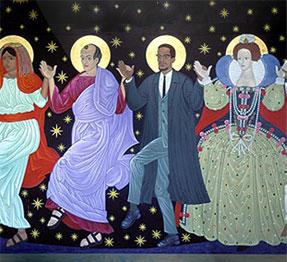
I  love the “dancing saints” at St. Gregory of Nissa Church in San Francisco.  Completed in 2009, this wonderful 3,000 square foot painting depicts a staggering variety of traditional and surprising saints depicted in a style that recalls ancient iconography and yet all of them are dancing.  The artist,  Mark Dukes, collaborated with the congregation to select and choose the individuals in the painting so that “as the congregation dances around the altar, the saints dance above, proclaiming a sweeping, universal vision of God shining through human life.”

Placing icons of saints in a church is hardly new, although St. Gregory’s has definitely turned this old tradition into a vibrant new expression of 21st century postmodern faith.  This painting also makes the unique vision of this congregation visible and clear.  Gazing upon the unusual juxtapositions of Biblical figures with 20th century “saints” such as Harvey Milk, Anne Frank, and Malcolm X (dancing with Queen Elizabeth I) instantly conveys a vision of inclusion that makes the visitor to the church know this church is not your average church.

Yesterday was Reformation Day and it was a delight to think a bit about our spiritual ancestors from the reformed tradition including Martin Luther, Jean Calvin, and Huldrych Zwingli. The collective reforms they wrought on a corrupt medieval church were breathtaking and continue to inform the practice of many, many people all over the world, whether they participate in church or not.

The influence of Zwingli, who decried all paintings, statuary, and even pipe organs in churches, lives on in the sparse, image-free architecture of many American churches.  We may have brought musical instruments back (even thought there is a tendency to hide organ pipes) and learned to enjoy art again, as long as its’ relatively abstract, but “symbols” in the sanctuary are generally limited to baptismal font, communion table, and pulpit.  No dancing saints for Zwingli!

doctoraldragIn many churches that inherited the reformed tradition, the practice of pastors wearing medieval academic regalia including “Calvin” tabs continues.  When I was a child, that black academic gown, hood, and the “tabs” that my childhood pastor wore stood out – like the dancing icons at St. Gregory’s – from what other pastors in our small town wore during worship.  It proclaimed a commitment to an educated clergy and to a literate laity. And it was accurate: our pastors were highly-educated and the members of the church held many academic and professional degrees.

Most of the churches in my small town in Texas were conservative and evangelical and their ministers did not attend seminary and often only had a high school diploma and a couple of years at Bible college.  For those churches, a pastor (who was always a man) wore a suit and tie and never, ever, never wore an alb-style robe like the Catholic priest (who was Hispanic and the mass was conducted in Spanish) nor did they ever wear the black Geneva gown worn by my Presbyterian minister.

These evangelical pastors’ wardrobe symbolized their commitment to the “priesthood of believers” and their heartfelt desire to not “lord it over the people”.  It also said something about their often hostile views of higher education.

They thought our pastor’s robe was offensive and it didn’t help that my pastor’s Geneva gown also made him look like a judge since the same garb is worn by the judiciary. And in the 1970’s, the great refrain from Laugh-In of “here comes da judge”, was certainly a running joke within my Presbyterian youth group every time our pastor appeared in his robe.

Flash forward to 2013, however, and liturgical drag has become as diverse as our churches.  In many progressive congregations that I have served, the minister might wear an alb that recalls the medieval garb for baptism with a stole and perhaps even a cincture that might be a salute to contemplative monasticism.  The alb is also thought to more closely resemble the first century clothing worn by Jesus and the disciples.

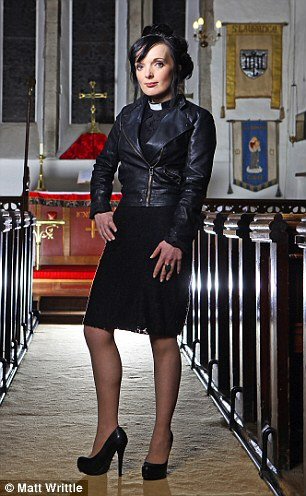
This brave new woFemale+Priestrld of liturgical “drag” also raises certain subtle issues related to gender.  It is harder for clergywomen to figure out what to wear when they preach if robes are not an option.  In a perfect world, it wouldn’t matter, but in the real world these things do matter.

This is a constant conversation amongst clergywomen who have gotten into trouble in a particular church because a skirt was too short, a neckline too low, jewelry too flashy, or in the case of one friend, her breasts were too visible because a too narrow stole got tucked beneath her arms thereby emphasizing her breasts.  On the hilarious, but really very serious website, revgalblogpals,  you can purchase a t-shirt that asks, “does this pulpit make my butt look big?”

Dressing like those in the pews these days, especially in California, might lead to shorts, t-shirts, and flip-flops and I wonder whether a preacher would be taken seriously in such casual attire.  And I’m absolutely sure that a dressed down man would be more acceptable in the pulpit than a dressed down woman – especially in shorts.

The Geneva gown still makes an appearance in progressive circles, but is usually reserved for Lent and Holy Week (and Reformation Day?) to provide a more somber look.  Some ministers have created liturgical outfits with many multicultural references from their justice commitments.  Cotton shirts from Hawaii, Mexico, the Philippines or dashikis from West Africa are common.  Some clergy friends wear kimonos or saris, depending on their commitments, personal taste and personal budget for special clothing.

Amongst “emerging” christians  – many of whom have left church buildings behind and are now leading worship services in bars and coffeehouses – tattoos, piercings, and leather jackets are common.  Check out progressive, emerging church pastor Jay Bakker’s website  to see this sort of liturgical look. (yes, he is the son of televangelists Jim and Tammy Faye Bakker)

In churches committed to diversity, it seems to me that a wide-variety of clerical garb and liturgical garments could be enjoyed as a reflection of the many wells that congregants draw from for their faith.  The monastic alb tends to appeal to those who value contemplative practice.  A Geneva gown certainly recalls the commitment to an educated clergy when it is worn in worship.  Creative and multi-cultural stoles and robes testify to our globally-connected commitments to social justice.
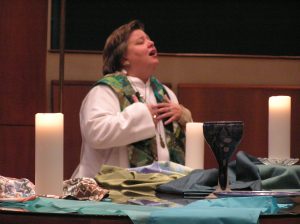
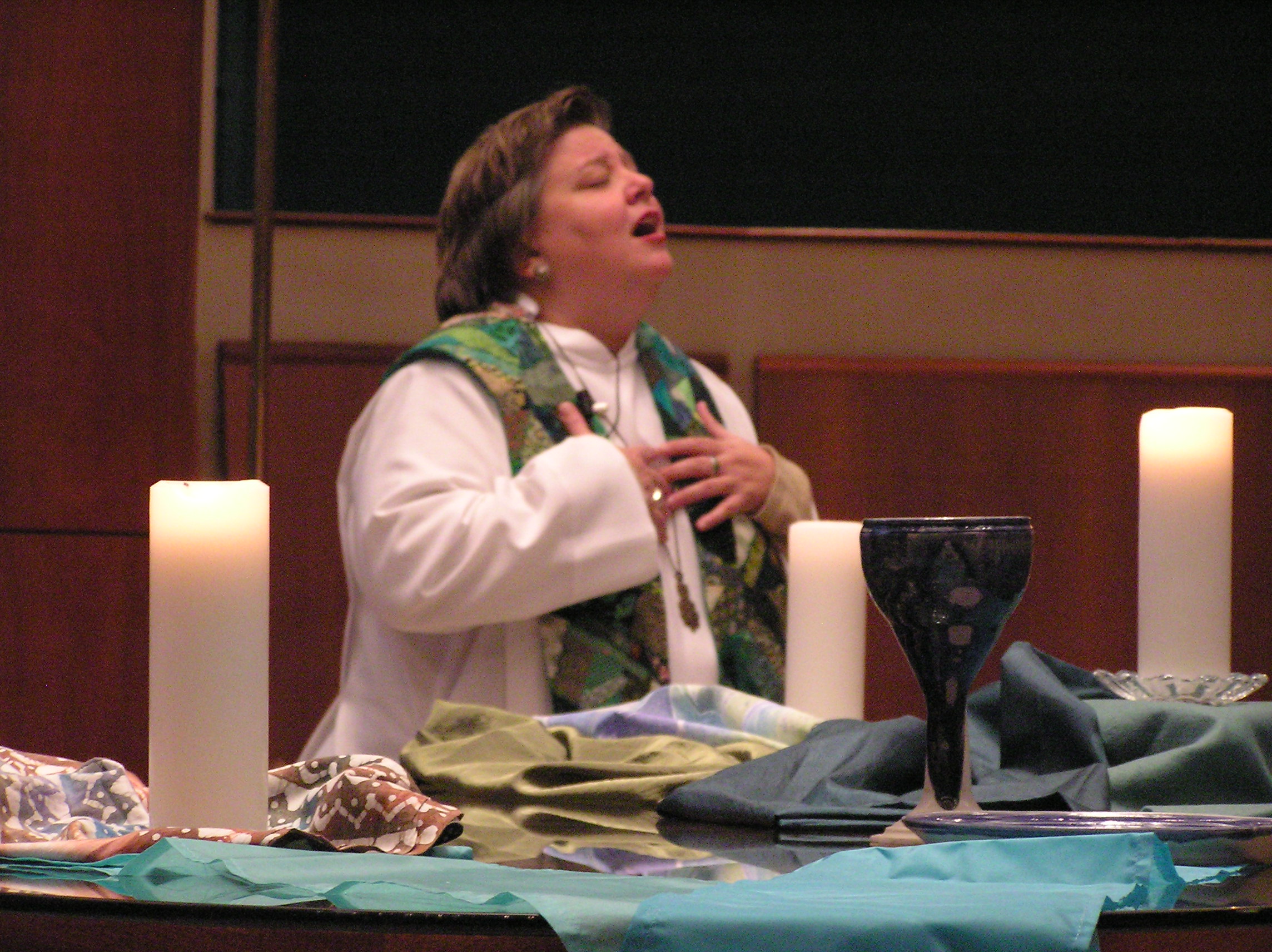
OLYMPUS DIGITAL CAMERAFor myself, I like to wear robes (I own a white alb, an indigo cassock, and a Geneva doctoral gown that I bought when I got my D.Min.) and a beautiful collection of stoles (many made by a professional quilter in Marin County) because they make my wardrobe choices simpler.

These garments can also add beauty to worship in much the same way that banners and beautiful flower arrangements make the church seem like a special place and not just another space for getting together in community.  Wearing liturgical drag is also a bit like wearing a costume in the theater, it helps me to be “in character” and to draw my frail human self up to the task of preaching and leading worship.

It is also true that when I wear liturgical vestments, and I am also open about my identity as a lesbian, I am claiming important symbolic ground in the culture wars over the ordination of lgbt folks (and women, for that matter)  So as a woman and as an out lesbian, the wearing of liturgical drag is a positive symbol of great change in some churches and a symbol of resistance in a culture that still does not always affirm this complex identity.

Symbols matter in a church.  Symbols provide subtle – and sometimes not so subtle – statements about the identity, theology, and practice of a local church.  But symbols also have to keep pace with the times and when it comes to liturgical garments, the commitments and identity of the one wearing the clothes also matters along with the identity of the community that minister is called to serve.

 

The Art of Being Church

Friday, October 25th, 2013

View just this post

flowers-of-fireThe miracles of the church seem to me to rest not so much upon faces or voices or healing power coming suddenly near to us from afar off, but upon our perceptions being made finer, so that for a moment our eyes can see and our ears can hear what is there about us always. –  Willa Cather, (1873 -1947) U.S. novelist, poet and journalist

Over the years I have laughed at art critics and historians talk about the abstract expressionism of the great painter Georgia O’Keefe.  Her paintings seem quite realistic to me because I have spent a lot of time in the high deserts where she painted things pretty much the way they actually look, albeit from different perspectives.  For her flowers, she zooms in on the minute details, while her landscapes are sweeping vistas replete with the amazing colors of New Mexico.  But if you’ve never been to New Mexico, these forms seem completely unreal and truly abstract.

We all have the ability to perceive the same things quite differently once we take into account the way our experiences, education, and current life situation affect our ability to make sense of the world.  This is a wonderful gift AND it can be a source of difficulty in a diverse community.  The difficulty comes when any one of us simply assumes that others share our same point of view or worse yet that our point of view is exclusively correct.

I learned this the hard way. For nearly seven years I served as the one Euro-American pastor at City of Refuge, UCC, San Francisco.  City of Refuge is a predominately African-American, metho-bapta-costal United Church of Christ congregation filled with LGBTQQISGL folks. (I know I just lost some of you with THAT description – lesbian, gay, bisexual, transgender, queer, questioning, intersex, and same-gender loving – phew!) In that church none of us could take anything for granted and so we had to practice great hospitality towards one another.  We regularly had to wait for the Pentecostals to have their praise time.  The Pentecostals sat desperately while those of us who needed more silence took our time.  We had to learn to be patient with things we didn’t agree with and didn’t like as an act of radical hospitality towards our sisters and brothers.  I still find it hard to remember that “my way” is not the best way and that others have deeply held beliefs and preferred spiritual practices too.

The truth is that individual members of most churches – including Montclair Presbyterian – have many diverse ideas about congregational singing, prayer, preaching, and communion.  I know this because you’ve told me in person, or on a white card, or in an email what kind of prayer you do and do not like and so forth.  This is great to know!

It’s also impossible for all of you to get what you prefer on any given Sunday.  As I said in my first sermon, everyone will probably be frustrated with me at one time or another as I try to figure out how to “serve all of you – some of the time” instead of choosing to serve “some of you- all of the time.”  While your diversity may not look as dramatic as the diversity of City of Refuge, you do have a wide range of theological conviction and spiritual practice.

Over the next few weeks, we will use our Sunday Celebration time to explore “Why Church?” and I look forward to hearing from many of you what really makes your heart leap and spirit soar here at Montclair.  And through this process, we will continue to map out what really is the “MPC style” and we will continue to find ways to distill the wonderful work of the Mission Study into easily-shared, bite-sized tastes of what a new pastor or visitor might experience as part of this wonderful community.

Our investigation will not be limited to worship, but I hope will spread throughout our activities to encompass how we treat one another in committees, task forces, and in all our interactions.

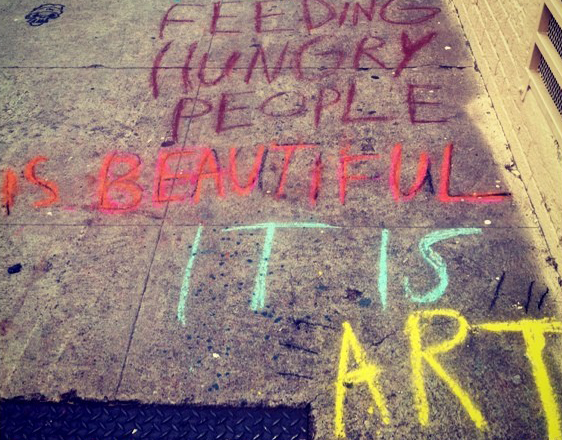
feeding-the-hungryFor example, there is a great desire among many of you to be engaged in a hands-on food program of some sort.  But there are great differences among you in terms of schedule and physical abilities and you even have some philosophical differences about what constitutes a beneficial program.

So while some retired adults can volunteer during a weekday that will not work for the youth (who really want to do something meaningful in this area!) and it will not work for other working adults.  The Fruitvale food pantry is a worthy activity, but it cannot accommodate a whole youth group as volunteers and so it isn’t enough to satisfy our community’s desire to serve.  Philosophically, some would like to identify needs close to the church and others insist that our efforts be limited to the more obviously poverty-stricken areas of Oakland.  Some want to host dinners and/or provide lunches and others want to be part of a food pantry.  My own contribution to the conversation is to look for partners who are already providing a good service, but could benefit by our participation to create more capacity.

All of these points of view are valuable and helpful, but it is extremely important that we not become paralyzed by these differences and fail to act at all.  We have to keep having theses conversations, gathering additional information, and inviting even more voices to the table to see if we can begin to see a path or paths (!) for this ministry. Feeding the hungry – and in fact “being church” – isn’t a zero-sum game.  The needs are greater than our combined creativity and many approaches can be beneficial.

A Hindu proverb states:

There are hundreds of paths up the mountain, all leading to the same place, so it doesn’t matter which path you take. The only person wasting time is the one who runs around the mountain, telling everyone that his or her path is wrong. 

May all our divergent paths lead us towards one another and toward our shared desire to serve a hurting world.


Just-Us Church

Friday, October 18th, 2013

View just this post

emptychurchOne of the most telling differences among individual American churches lies in their approach to the world beyond their doors. In my mind there are two major camps:  the “just-us” churches and the “justice” churches.

For some congregations, the “just-us” sort,  interactions with the wider community are strictly limited to their evangelism efforts.  In such churches, members are encouraged to invite their friends, acquaintances, co-workers, dry cleaner, dog groomer, or whoever to come to their worship services.  The goal of these invitations is to “win souls for Christ”.  The invitation to participation in such communities assumes that the visitor will (hopefully!) become “one of us” and will adopt the primary religious beliefs of that congregation.

Traditionally, these “evangelical” churches limited their outreach to “soul winning” and they stayed away from anything political AND they did not engage in ministries in the community separate from that goal such as food pantries or other programs to address poverty.  In such churches, there are ministries of care for “members” such as taking casseroles to a grieving family or other such kindnesses, but those ministries to those in need stay “inside the house” and do not usually venture forth to provide food, shelter, clothing, or other support to strangers beyond their doors.

Meanwhile, whole other swaths of Christian churches have always been engaged with the wider community without any emphasis on spreading their beliefs or even inviting folks to attend their church services.  For these, “justice”or “mission-oriented” churches; hosting a food pantry, homeless shelter, and/or providing various other social services is a highly-desired activity.

All of these sorts of congregations, through their denominational connections, sponsor “missionaries” throughout the world.  But these mission workers can be similarly divided – like their parent churches – into those who are going to other countries for the purpose of “soul-winning” or “service”.

Having been a Presbyterian or member of the United Church of Christ all of my life, I have always been part of “justice-oriented” congregations that engaged in the wider community to serve the hungry, the poor, and those who are oppressed.  My spiritual ancestors have also engaged in struggles for justice at home and abroad for hundreds of years moving beyond attention to those in need to becoming advocates in the public sphere.  We’ve worked to abolish slavery, end apartheid, and now we are on the cutting edge of movements to address climate change, economic inequality, and the growing prison-industrial complex, to name a few.

In my experience, many people are really confused by these very different ways of “being church”.  And for those of us who do not engage in any “soul winning” sort of evangelistic outreach, we often bristle when there is any suggestion of doing “outreach” that does not have “justice” or social service at its’ core.  We are delighted to work in the food pantry, but are allergic to speaking of our faith to others.

The irony is that we are prone to become just as isolated from the wider community as those “just-us” churches that only focus on “soul-winning” when we fail to link our love for our faith community AND our faiths and beliefs to our service in the wider community.  This isn’t easy for us progressive religious types.  We really are opposed to anything that looks like evangelism.

And yet, we love our faith communities.  We truly value being part of a church family.  We are dedicated to our spiritual growth and to sharing that journey “inside the house” with our sisters and brothers.  Part of our problem is that many of us have a hard time describing our faith to others.  We don’t really have the words or courage to share what we believe (or don’t believe) with ease.  This is especially hard for a community like Montclair where wide theological difference is the norm.

So . . . when the opportunity arises, what say you?  What words shall we borrow to describe our common life together?  How do we invite others to join us in our “justice” church so that we don’t become a “just-us” church?

Starting on Sunday November 3rd, we will begin to explore what it means to be church in these first years of the 21st century.  What’s new?  What’s old?  What still works? What needs some attentive change?  This would be a swell time to attend Celebration regularly and . . . you might even invite your friends too.