
 There are a lot of options in the Bay Area when it comes to community groups, spiritual paths, and places to be of service. What makes a church different? What can we do together as a group that cannot be done in other ways? Last week, we looked at “why church” from the perspective of what an individual or family can gain from being part of a church. This week, we will explore “why church” in the larger scheme of things. Do churches such as Montclair Presbyterian have a particular to role to play in the community? in the culture? Do join us at 10:00 a.m. on Sunday.
Posts Tagged ‘Pastoral’
Why Church?
Wednesday, November 6th, 2013
The Power of Symbols
Saturday, November 2nd, 2013
 Happy All Saints Day!
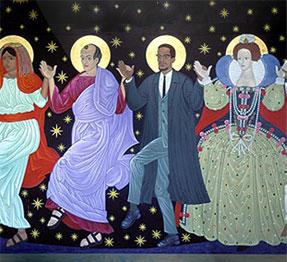
I love the “dancing saints” at St. Gregory of Nissa Church in San Francisco. Completed in 2009, this wonderful 3,000 square foot painting depicts a staggering variety of traditional and surprising saints depicted in a style that recalls ancient iconography and yet all of them are dancing. The artist, Mark Dukes, collaborated with the congregation to select and choose the individuals in the painting so that “as the congregation dances around the altar, the saints dance above, proclaiming a sweeping, universal vision of God shining through human life.”
Placing icons of saints in a church is hardly new, although St. Gregory’s has definitely turned this old tradition into a vibrant new expression of 21st century postmodern faith. This painting also makes the unique vision of this congregation visible and clear. Gazing upon the unusual juxtapositions of Biblical figures with 20th century “saints” such as Harvey Milk, Anne Frank, and Malcolm X (dancing with Queen Elizabeth I) instantly conveys a vision of inclusion that makes the visitor to the church know this church is not your average church.
Yesterday was Reformation Day and it was a delight to think a bit about our spiritual ancestors from the reformed tradition including Martin Luther, Jean Calvin, and Huldrych Zwingli. The collective reforms they wrought on a corrupt medieval church were breathtaking and continue to inform the practice of many, many people all over the world, whether they participate in church or not.
The influence of Zwingli, who decried all paintings, statuary, and even pipe organs in churches, lives on in the sparse, image-free architecture of many American churches. We may have brought musical instruments back (even thought there is a tendency to hide organ pipes) and learned to enjoy art again, as long as its’ relatively abstract, but “symbols” in the sanctuary are generally limited to baptismal font, communion table, and pulpit. No dancing saints for Zwingli!
 In many churches that inherited the reformed tradition, the practice of pastors wearing medieval academic regalia including “Calvin” tabs continues. When I was a child, that black academic gown, hood, and the “tabs” that my childhood pastor wore stood out – like the dancing icons at St. Gregory’s – from what other pastors in our small town wore during worship. It proclaimed a commitment to an educated clergy and to a literate laity. And it was accurate: our pastors were highly-educated and the members of the church held many academic and professional degrees.
Most of the churches in my small town in Texas were conservative and evangelical and their ministers did not attend seminary and often only had a high school diploma and a couple of years at Bible college. For those churches, a pastor (who was always a man) wore a suit and tie and never, ever, never wore an alb-style robe like the Catholic priest (who was Hispanic and the mass was conducted in Spanish) nor did they ever wear the black Geneva gown worn by my Presbyterian minister.
These evangelical pastors’ wardrobe symbolized their commitment to the “priesthood of believers” and their heartfelt desire to not “lord it over the people”. It also said something about their often hostile views of higher education.
They thought our pastor’s robe was offensive and it didn’t help that my pastor’s Geneva gown also made him look like a judge since the same garb is worn by the judiciary. And in the 1970’s, the great refrain from Laugh-In of “here comes da judge”, was certainly a running joke within my Presbyterian youth group every time our pastor appeared in his robe.
Flash forward to 2013, however, and liturgical drag has become as diverse as our churches. In many progressive congregations that I have served, the minister might wear an alb that recalls the medieval garb for baptism with a stole and perhaps even a cincture that might be a salute to contemplative monasticism. The alb is also thought to more closely resemble the first century clothing worn by Jesus and the disciples.
This brave new wo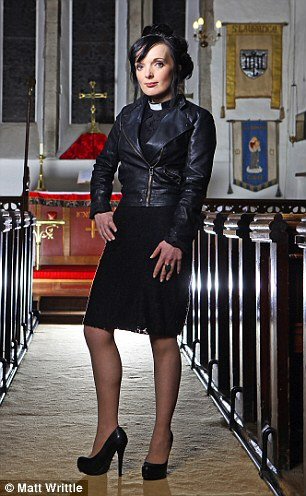 rld of liturgical “drag” also raises certain subtle issues related to gender. It is harder for clergywomen to figure out what to wear when they preach if robes are not an option. In a perfect world, it wouldn’t matter, but in the real world these things do matter.
This is a constant conversation amongst clergywomen who have gotten into trouble in a particular church because a skirt was too short, a neckline too low, jewelry too flashy, or in the case of one friend, her breasts were too visible because a too narrow stole got tucked beneath her arms thereby emphasizing her breasts. On the hilarious, but really very serious website, revgalblogpals, you can purchase a t-shirt that asks, “does this pulpit make my butt look big?”
Dressing like those in the pews these days, especially in California, might lead to shorts, t-shirts, and flip-flops and I wonder whether a preacher would be taken seriously in such casual attire. And I’m absolutely sure that a dressed down man would be more acceptable in the pulpit than a dressed down woman – especially in shorts.
The Geneva gown still makes an appearance in progressive circles, but is usually reserved for Lent and Holy Week (and Reformation Day?) to provide a more somber look. Some ministers have created liturgical outfits with many multicultural references from their justice commitments. Cotton shirts from Hawaii, Mexico, the Philippines or dashikis from West Africa are common. Some clergy friends wear kimonos or saris, depending on their commitments, personal taste and personal budget for special clothing.
Amongst “emerging” christians – many of whom have left church buildings behind and are now leading worship services in bars and coffeehouses – tattoos, piercings, and leather jackets are common. Check out progressive, emerging church pastor Jay Bakker’s website to see this sort of liturgical look. (yes, he is the son of televangelists Jim and Tammy Faye Bakker)
In churches committed to diversity, it seems to me that a wide-variety of clerical garb and liturgical garments could be enjoyed as a reflection of the many wells that congregants draw from for their faith. The monastic alb tends to appeal to those who value contemplative practice. A Geneva gown certainly recalls the commitment to an educated clergy when it is worn in worship. Creative and multi-cultural stoles and robes testify to our globally-connected commitments to social justice.
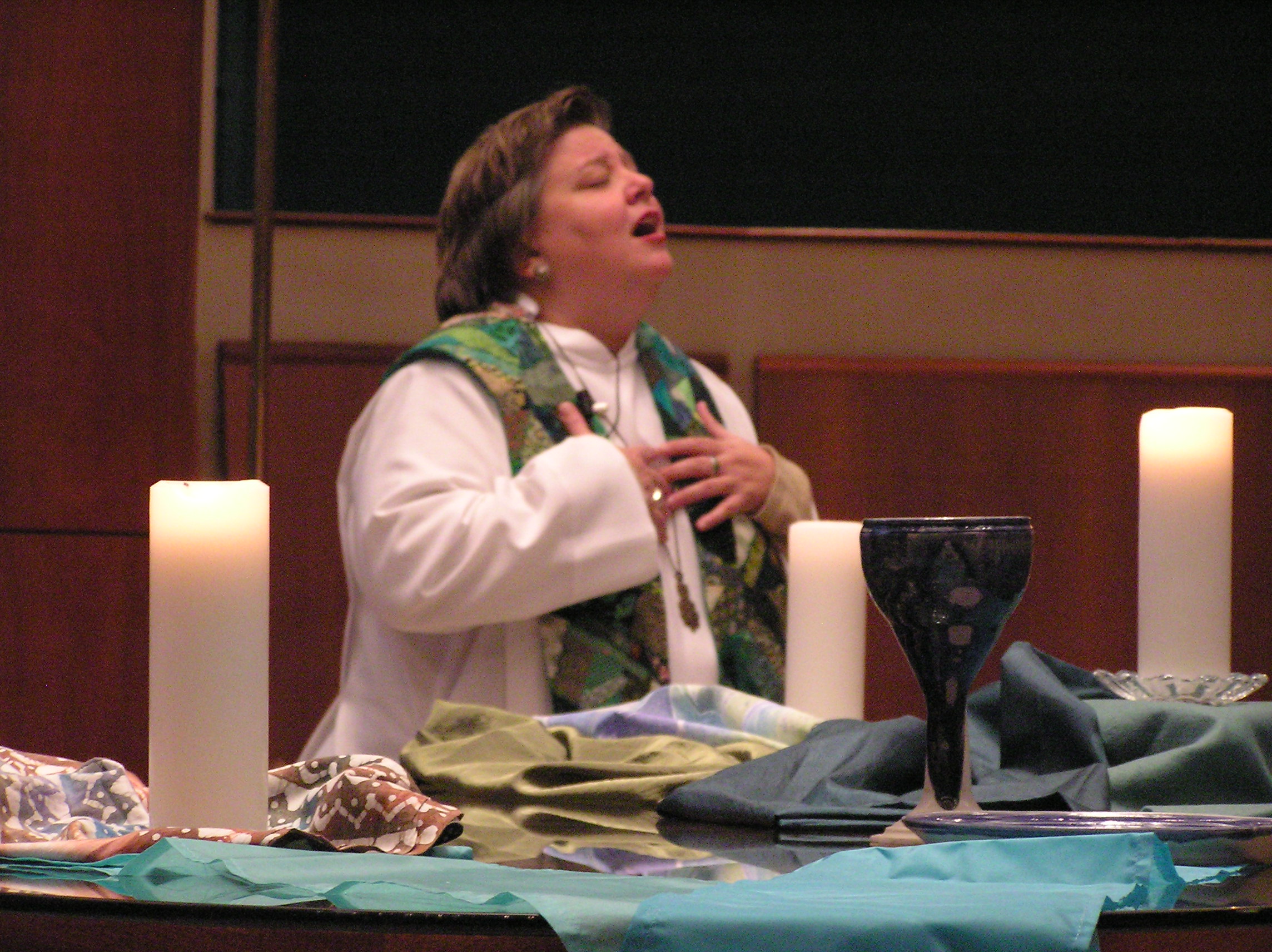 For myself, I like to wear robes (I own a white alb, an indigo cassock, and a Geneva doctoral gown that I bought when I got my D.Min.) and a beautiful collection of stoles (many made by a professional quilter in Marin County) because they make my wardrobe choices simpler.
These garments can also add beauty to worship in much the same way that banners and beautiful flower arrangements make the church seem like a special place and not just another space for getting together in community. Wearing liturgical drag is also a bit like wearing a costume in the theater, it helps me to be “in character” and to draw my frail human self up to the task of preaching and leading worship.
It is also true that when I wear liturgical vestments, and I am also open about my identity as a lesbian, I am claiming important symbolic ground in the culture wars over the ordination of lgbt folks (and women, for that matter) So as a woman and as an out lesbian, the wearing of liturgical drag is a positive symbol of great change in some churches and a symbol of resistance in a culture that still does not always affirm this complex identity.
Symbols matter in a church. Symbols provide subtle – and sometimes not so subtle – statements about the identity, theology, and practice of a local church. But symbols also have to keep pace with the times and when it comes to liturgical garments, the commitments and identity of the one wearing the clothes also matters along with the identity of the community that minister is called to serve.
Commuting Fear
Saturday, September 7th, 2013
 Anything scares me, anything scares anyone but really after all considering how dangerous everything is nothing is really very frightening. – Gertrude Stein in Everybody’s Autobiography (1932)
My first two weeks of commuting to Montclair from our home in San Francisco have been way more interesting than we might have expected! The first week, the Bay Bridge was closed and I left our second car in Sari Kulberg’s driveway and used BART to go back and forth. (thanks Sari!) This worked quite well, although it took nearly 90 minutes on Sunday the 1st because I just missed a K-Owl on Market street and then had to take a 33-Stanyan to the 16th and Mission station only to discover that BART wasn’t open yet at that station.
Now you might not know that I’ve lived in San Francisco for most of the 22 years that I’ve lived in the Bay Area. And in the late 90’s, I did needle exchange and street outreach late, late at night in the Polk street neighborhood. My ministry in those days also included a regular shift at the Ambassador Hotel in the Tenderloin via the Listening Post, a program sponsored by the Rev. Glenda Hope’s amazing Network Ministries. So, I’m pretty street-wise and not easily intimidated by the usual bad smells and scary behaviors that happen amongst San Francisco’s hardcore homeless and/or drug-addicted population.
But on Sunday morning September 1st, because I was on my way to Montclair church for Sunday Celebration, I was in a good suit and not dressed for street outreach. As a result, I stood out in a way that was somewhat uncomfortable for me and it seemed like a bit of a curiosity to those hanging around the station. I found myself clutching my bag and a smidge fearful. But I have learned that fear in not only an unhelpful response (it makes you stand out even more!) but it is also disrespectful because it communicates disapproval to those who live in that neighborhood. So, I took a deep breath and struck up a conversation with a couple of other folks waiting for the station to open. Just small talk about the weather, the bridge project, etc. and my anxiety began to decrease. By creating a small pocket of “community”, I was able to manage my fear and relax.
My second week of commuting brought another set of more welcome changes. The new Bay Bridge is absolutely beautiful! My first morning driving across it was magical. It feels like you are riding on the deck of an enormous sailboat and gliding across the Bay.
But what I welcomed as a wonderful adventure, I discovered was another opportunity for fear when a friend of mine said, “I’m never going to drive on that bridge. Who knows how it will do in an earthquake with faulty bolts and substandard steel from China?”
Certainly his concerns have some validity and they have been rightly raised throughout this long, long, and absolutely obscene, political process of building the new bridge. I also have justice concerns myself about whether spending six billion plus for a new bridge was a wise use of resources when the old bridge could have been retrofitted for a fraction of that cost.
But am I afraid to use the new bridge? Nope. My lack of fear of the new bridge is partly because I’ve been regularly driving across the old bridge for over 20 years knowing that it has not been retrofitted and that it isn’t just likely to fail in an earthquake, it has already failed in an earthquake. I also regularly ride through BART’s Transbay Tube and the retrofit of that structure isn’t complete. I have served churches located on ALL the major faults in the Bay Area. Worst of all, I’m a regular pedestrian in the City and that is truly high-risk in a statistical sense.
This little meditation on fear does chronicle some of my own successes in this area of spiritual and emotional development, but don’t think that I have it all handled. You will definitely see uncontrolled and irrational fear should a snake come onto campus. It will be embarrassing and quite dramatic as I break into a cold sweat and heart palpitations. (try not to laugh – it doesn’t help) For those of you who are joining me for walks, let’s hope we don’t find any of them on those journeys either. But if we do, just know that I will probably be useless.
So here’s my question for all of us: what do you do when you find yourself beyond your comfort level and somewhat fearful? This happens to all of us in a variety of situations. It is normal and human to become afraid and/or anxious in the midst of change or whenever we encounter something different than what we expect.

My own knowing is that any way that I can create a pocket of community at the point of my fear is really helpful.
It helped at the BART station and it helps me when I think about earthquakes and other natural disasters that I know I will not be alone and that I have been part of the preparedness planning of many communities including my own neighborhood. And I am completely confident that if I encounter a snake, I do not want to be alone. When I’ve spent time on our family’s ranch in Texas, “in snake world”, I prefer to walk with a dog or be on horseback – just in case!
As we continue getting to know each other, I am listening for the moments of anxiety that exist within this community about the future of this church and for the anxiety and fears we may have individually. Feel free to speak with me if this blog has “rung any bells” for you or simply lean on your sisters and brothers in this community in whatever way you figure out. The Stein quote I put at the top of this is also helpful for me and so is my faith that no matter what happens, I can count on the love and strength of the holy one, too.
Not My Finest Moment…
Monday, April 8th, 2013
Don’t you just hate those times in your life when you completely lose it and turn in to someone you would rather not know exists? Come on, you know what I am talking about…at least I hope you do because if you don’t it means I am even worse than I imagine! People have asked me what are my pet peeves. Here is one of my biggest pet peeves on the road: I put my blinker on to signal that I am changing lanes. There is a car ahead of me and a car behind me and I am confident that there is room in the lane for my car. After signaling, I begin to move over. When I am halfway into the lane, the car behind me steps on the gas and then lays on the horn and tries to blast me right off the road. ARE YOU KIDDING ME?????? At that moment, I not only have a pet peeve but that person BECOMES my pet peeve. Sometimes I handle those moments with some grace and I forgive those debts as mine have been forgiven. Not last week.
Last week when the young woman behind me became my number one pet peeve on the road, I lost it. In two seconds I went from being a fairly rational, kind, compassionate person to an absolute screaming meany. One second I was having a nice phone conversation with our youngest daughter through the wireless system in the car and the next second I was screaming at the top of my lungs and gesturing with both hands (don’t worry, no middle fingers were involved – that is definitely beneath me…) and trying to make my neck swivel 180 degrees all at the same time. As if I hadn’t already made a big enough fool of myself, the young woman had the nerve to then change lanes and pull up beside me and give me attitude. Picture snakes on the side of my neck because that is how thick my veins must have looked with the anger coming out of my very pores. I turned my head to the side and screamed at her some more about the brilliant use of blinkers and how she would do well to pay attention to them and on and on. My onramp came up so I split to the right and she kept going and I tried to catch my breath and then I remembered our youngest daughter was still on the phone listening to my tirade. She quickly ended the phone call after that and I was left to my own company. Yikes.
As I drove down the highway, I marveled at how quickly I had come unglued. My day had been fairly good up to that point so I knew it must be something deeper. What I realized is that even though I am good at “being strong” and “keeping it together,” just beneath my calm, cool and collected exterior is an anxious and stressed out interior. It was the day before Easter and I was supposed to be preach something about how resurrection is what happens when we each live as Christ in this world and I could have been arrested for indecent being! Thank God for those times that we see ourselves in a mirror and do not like what we see and can then choose to do something about ourselves. Most things in life come down to faith or fear, even for those who are not religious. If you look at my life you can trace the lines to faith or fear. Turning into a monster in a moment is a line that can be traced to fear. From there we can choose faith. The rest of my drive that day before Easter was spent thinking about how God has my back and will not let me crash on the rocks. The next time someone becomes my pet peeve, I will try to choose faith and live resurrection. Until then, I am breathing deeply and taking one day at a time.