

Author Archive

The Haircut Connection

Thursday, April 21st, 2016

View just this post

Before we left on our whirlwind trip to France two weeks ago, Anne and I had to confront the fact that we hadn’t finished doing everything that needed to be done before we left. For example, I never got around to making a proper packing list, which was a little stressful. I tried to make it better by reminding myself that people have been living in France for thousands of years without any of my stuff, so if I forgot to pack something I’d probably be able to figure out a way to manage.  Anne never made it to the salon for a pre-trip haircut, so she told herself that she’d just have to get coiffed in France.

Anne’s hair solution came with a hitch, however. There were a lot of salons in Evian, the town where we were staying, and how does a person choose which salon is the right one when one is only passing through and doesn’t really speak that much French anyway? We spent a bit of time sizing up various salons, trying to guess which one would provide a good haircut, and trying to discern which was more like a Super Cuts operation. Personally, I would have given up and waited to get my hair cut at home. And that might have happened, except that on our last day in Evian we went to the train station to make reservations for our journey to Paris and the woman who helped us with our tickets was really nice and she had good hair.  She spoke English, so Anne asked her where to get her hair cut in Evian.

Before long, women working in various capacities in the train station got involved in the conversation. The gathered council of women arrived at a consensus opinion: Nadine over at N & C Salon on the far side of Evian, a part of town we had yet to explore.

So that’s where Anne went. She got a good haircut, but more than that she had a great time. Nadine was kind, and she brought in her English-speaking daughter to translate. Together the three women had a lovely time together, all of which was made possible because Anne was willing to connect with a train station employee as more than just a seller of tickets.

By reaching out to the ticket seller as a human being who got her hair cut, Anne created a community for herself in Evian, and it strikes me that we should be doing this everywhere we go. We should think of the random people we meet–wait staff, cashiers, people walking their dogs, fellow drivers on the road–as human beings with needs and wants similar to our own. And when we do, we will create community, and in that community will encounter Christ.

And, as a bonus, we might get a good haircut.

Peace,

Ben
 

Safe Church, Safe Children

Wednesday, April 20th, 2016

View just this post

Our church is doing a new thing which we can all be proud of, even though it hasn’t happened yet. We’re still a month or so away, but please, consider yourself invited to puff up your chests and pat one another on the back, because we are running a training to address a very important issue. Not only that, but we are calling in an expert from a nearby Presbytery, and inviting other local congregations to participate in this most important event. Congratulations!

Well, we need all the pride and appreciation we can get, because it isn’t going to be an easy training.  We are gathering together on May 21st to talk about how we can avoid and prevent abuse in our church, including the physical, emotional, and sexual abuse of children and vulnerable elders. Jane Odell, from San Jose Presbytery, will be leading a class for many of us, especially staff, Godly Play teachers, nursery volunteers, Youth Group advisors, and session members. It won’t be pretty, but it will be important. We will be thinking about unthinkable crimes, and looking for ways we can improve our policies and practices to reduce even the possibility of such crimes happening here.

Presbyterians might be rightly accused of being cynical, but we have a strength in our cynicism. We acknowledge that people do not always do what they ought to do, and that this is common to all – not just in the outlying “bad apples,” but in each person, and moreover that our misdeeds are compounded systemically and culturally, especially when power dynamics come into play . In other words, and churchier words, “we confess the persistence of sin in our corporate and individual lives” (PCUSA Book of Order, F1.0302-b). In even simpler words, if something can possibly go wrong, we expect it may. Because of this, we believe that our systems of power must be well checked and balanced against one another. And when possible, safeguards should be put in place. This training will help us identify places we need safeguards, and will help us all to be alert to risks and dangers so that we can keep everyone safe.

If you are interested in volunteering with the children of our church in the next year – whether in nursery, Godly Play, youth group, retreats or mission trips – we strongly urge you to attend this training! For more information, see our flyer posted on the website. (link) Big thanks to the Children and Youth Education Committee, and our chairperson Marilee Niemi, for taking this project on.

Every Blessing,

Talitha


Please note Rev. Talitha will be out of the office next week, meeting with her cohort for the Company of New Pastors.


A NEW BOTTOM LINE

Wednesday, April 6th, 2016

View just this post

Dear Friends,

I loved hearing from Rabbi Michael Lerner on Sunday. Rabbi Lerner is a person of great wisdom and insight. His words have had a profound impact on people from the streets of Berkeley to the White House, and it was a deep privilege to have him in our pulpit.

One of Rabbi Lerner’s ideas that I find particularly attractive is his suggestion that our society needs to develop and articulate what he calls a “new bottom line”. The idea for a new bottom line is this: under our culture’s current value structure the bottom line refers to financial success and/or influence and power, such that an enterprise is deemed valuable and successful when it makes money or has a broad impact. In contrast, a new bottom line would see an organization or enterprise as successful when it furthers the wellbeing of humanity and fosters the health of creation. This concept is similar to what is articulated eloquently in the late Lou Mudge’s book We Can Make the World Economy A Sustainable Global Home, which a number of us are in the process of studying.

It’s a beautiful idea, but for me there is a rub: I have an easy time dreaming of a world where the business ventures of the “one percent” are guided by compassion and environmental sensibility. It’s nice when the new bottom line applies to others and is someone else’s responsibility, but I suspect it applies to us as individuals as well. This means that if I am going to take the idea of a new bottom line seriously, then I have to start judging myself not by how much money I earn or by how much time I spend in the office, or by how much influence I have, but by the extent to which my life is making the world a better place for all God’s children and, indeed, for every living thing.

That’s a little bit harder, but I decided to give it a try this week when I had a meeting in Pleasanton on Monday afternoon. It would have been an easy enough drive–to Pleasanton before the commute hours, and then home with a reverse commute. Had I driven I would have had an extra hour or so in the office, where I would have been productive in one way or another. But living according to a new bottom line compelled me to get to my meeting using a combination of bike and BART, which was a little bit complicated. I had to pay close attention to a time-table. I had to make two transfers. I had to find a place for my bike on the train, and I had to trust that the church office would survive without me.

My journey was not entirely unproductive in the traditional sense–I wrote this Contact piece on the BART, for example, and I provided pastoral care to a Salvadorian immigrant who had been physically assaulted by her boss–but mostly, living by a new bottom line meant I had to readjust my expectations of what should be accomplished in a day of working, and that wasn’t easy. In fact, I found myself feeling kind of sorry for big corporations. If it’s hard for me to adjust my life to embrace a new bottom line, how much harder must it be for a corporation like Monsanto, or Halliburton, or DuPont? Yet they must change. The survival of the planet and the wellbeing of humanity depend upon it. And I must change as well.

The takeaway for me is this: living according to a new bottom line, valuing that which heals the earth and nurtures the human family is not just something for the big cats. Each of us must change our value systems. Each of us must reorganize our priorities. In the end humanity isn’t decided between the one percent and the lower 99. All of us are in this together and each of us must do our part to embrace the new bottom line.

Peace!

Ben


Dare to Doubt

Wednesday, April 6th, 2016

View just this post

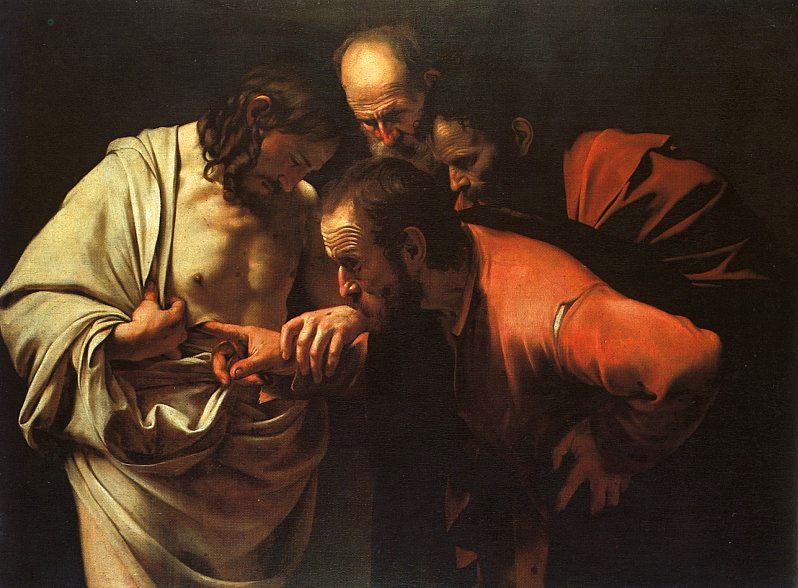
Caravaggio_-_The_Incredulity_of_Saint_ThomasHaving Rabbi Lerner as a guest preacher this week, we didn’t get to hear this story, but the week after Easter is traditionally Doubting Thomas’ Sunday. It’s a good Sunday to have guest preachers, actually… since the pastors are always exhausted after Holy Week. So, many a seminarian has cut their homiletical teeth, preaching their first sermon ever, on this Guest Preacher Sunday. I’ll point you to the scripture traditionally read (here: https://www.biblegateway.com/passage/?search=john+20%3A24-29&version=NRSV) , or remind those of you who know it well that Thomas insists he will not believe Christ is risen until he can touch his wounds with his own hands. Christ obliges, of course, at his next post-resurrection appearance, and says “Have you believed because you have seen me? Blessed are those who have not seen and yet have come to believe.”

Churches don’t always make a lot of room for doubts, but we should. Because Jesus did, for one, and because without doubters – the people who doubt, that is – we wouldn’t even have much church left. If you eliminated everyone whose beliefs differed from the party line, the church would be slim indeed. From the earliest days the church argued over almost everything, and even the central event of our faith – the resurrection – was up for debate, as Paul writes to the Corinthians, “if Christ is proclaimed as raised from the dead, how can some of you say there is no resurrection of the dead?” (I Cor  15:12). The history of our faith is so wide and diverse and full of disagreements, it’s foolish to try to sweep these differences of belief under the rug. They are nothing to be ashamed of, and in fact, they can be our strength.

I share this by way of invitation. One of our Family Life Small Groups, “Drinks and Doubts,” is due to begin next Friday 4/15, and there is still room for four or five more people to join us. It will be held on Fridays, 5:30-7 PM, at rotating locations (I’ll host the first one). RSVP to me if you’d like to join us, and bring your doubts out to play!

Every Blessing,

Talitha

PS I’ll be at Lake Tahoe on retreat with the youth group this weekend. Wish us well, and don’t expect any email replies from me until Tuesday when I’ve recovered!

Pictured above: https://en.wikipedia.org/wiki/Doubting_Thomas#