


Rev. Ben has been at General Assembly in Oregon the first part of this week. He returned today – welcome home!
Author Archive
The Language of Complicity
Wednesday, June 22nd, 2016
Dear friends,
How are you doing? It’s a nasty world out there right now. We are coming up on Pride Weekend (at least, Pride as it is celebrated in SF, though other cities celebrate other weekends) and I can’t help but think how different it is from last year. Last year the Supreme Court had just gifted our nation with a historic ruling on marriage equality, and the streets were brimming with unbridled joy. But this year, there will be security checkpoints and metal detectors on the streets of San Francisco, because in the wake of the Orlando shooting nobody can take any chances.
I saw a few articles following up on the Orlando shooter and suggesting that Omar Mateen was a deeply closeted, self-hating gay man who could find no other absolution for his sense of self-loathing than to go down in a massive martyrdom effort. As the story continues to unfold, a man who says he was a former lover of Mateen’s suggests the shooting was more vengeful than homophobic. There are probably more layers of meaning, and we may never know exactly what was going on in his mind. We know that self-hatred usually does not burst outward into murder (and is much more likely to be internalized in suicide), but due to other factors, from his cultural background to his mental health situation, this may have been the unusual road Mateen took.
Let’s not engage in too much speculation… but whether this story is true or false, I do want to comment on the suggested narrative in a theological sense, because it is a powerful one. The story of a person hating themselves so much they would die and kill to get rid of the misery rings true in a sense, and convicts us all. We know how homophobic our society is and how difficult it is for people to even internally accept their sexual orientations, much less to publicly come out. It is even harder for people in conservative religious groups (whether Christian, Muslim, or any other religion), and it tends to also be more difficult for people of color, depending on their community. So, we can accept our complicity in a society that has not yet made fully clear on every level that we have the freedom to love whom we love. We can accept our complicity, and ask for forgiveness even as we work to change our society.
MPC has for many years steered well clear of the language of sin and forgiveness. This is important for people who have been hurt by judgmental religion in the past, and especially those who have been told they are “sinners” because of whom they love. But I think we are missing something if we leave it out altogether. For one, we miss the chance to experience the lavish forgiveness of God, and of our loving community.
But more, we are missing the language of complicity. We all have a share of sin, because we take part in a society that lays waste the land, pollutes the seas, leaves hungry children unfed, allows semi-automatic weapons to be purchased over the counter, and leaves far too many LGBTQ people swamped in self-loathing and shame. We all have a share of sin, because even if we devote our lives to it, we cannot do enough to cure the social illnesses that plague our nation and our world.
The good news is that in Christ Jesus our sin is forgiven. And there is work to be done. As forgiven, beloved children of God, let us commit to this work with our whole heart and mind and strength.
Every Blessing,
Talitha
Monday, June 13th, 2016
Trigger warning – this is a serious post. A smiling blond man has taken over my newsfeed with a sickening frequency, and it’s not Donald Trump this time. Even the presidential election can’t overpower the big news story that all my friends are talking about. The Stanford rapist Brock Turner and his recent sentencing – a light sentence of only 3-6 months in county jail – has everyone up and angry.
Parents everywhere are shocked that Turner’s father would plead for such leniency, appealing to the emotional distress that caused his son to lose his appetite for snacks… while dismissing the suffering of the anonymous victim, who after all “only” suffered “twenty minutes of action”. Anti-racists everywhere are outraged as we compare Turner’s sentence to the sentences of Black folks who received harsher punishments for lighter crimes. Adding insult to injury is the fact that the media uses Turner’s yearbook photo rather than a mugshot (an informal honor that even Black crime victims rarely receive, much less convicted felons who are Black). Feminists are analyzing the technicalities of the definition of “sexual assault” vs. rape, and the injustice that allows a rapist’s future to be valued more than his victim’s. All lives matter? No, some matter more than others. Transgender activists just sit back and point out the ridiculousness that allows states to pass laws about what bathroom they are even allowed to enter (in fear of even the CHANCE that anyone be raped in a bathroom), but when a woman is actually assaulted by a cis-gendered male, her attacker receives the maximum benefit of the doubt. Accusations of Affluenza are flying like mad.
I’m not sure what I can add to this robust discussion, but I will point you in a few directions.
If you haven’t read the victim’s statement, please give it a few minutes to read. She wrote beautifully about the ugliest of subjects. https://www.buzzfeed.com/katiejmbaker/heres-the-powerful-letter-the-stanford-victim-read-to-her-ra?utm_term=.xa4MGny3v#.gbMb0PBax
If you are distressed about the judge’s lenient sentencing, there are various petitions addressed to his actions.
If you are concerned about any of the several the justice issues I’ve mentioned above, please allow these injustices to add fuel to your fire.
If you want to build a world where boys don’t grow up believing that they have the right to approach any girl for sex, and where they don’t think that the first few “no’s” are just part of the game to get to “yes”, where they know that nobody is “asking for” sex by any combination of their clothing, behavior, or intoxication level, and where they know that consent can only be given by consciously communicating peers, well, welcome to the fight. You might read this great blog on consent: http://rockstardinosaurpirateprincess.com/2015/03/02/consent-not-actually-that-complicated/ which we used on this year’s Youth Group retreat.
And if you are despairing… well, Ecclesiastes – that gloomiest of books of the Bible – between muttering “there is nothing new under the sun” and “everything is vanity” over and over, offers a small gem of (still gloomy) insight. “I have also seen this example of wisdom under the sun, and it seemed important to me. There was a little city with few people in it. A great king came up against it and besieged it, building great siege-works against it. Now there was found a poor, wise man, and he by his wisdom delivered the city. Yet no one remembered that poor man. So I said, ‘Wisdom is better than might; yet the poor man’s wisdom is despised, and his words are not heeded’.” (Eccl 9:13-16). If there’s something to learn from an example like this, I think it might be that the world always favors power… but we ought not to. Let’s work together toward a fairer and more equal society, where criminals are judged and victims are not; where wealth, race, gender and social standing don’t affect the outcomes of justice; and where sex is not a tool for assaulting another, but a beautiful gift of God to be enjoyed mutually. We’ve still got a long way to go, so let’s walk together and keep on encouraging one another.
Every Blessing,
Talitha
Monday, June 13th, 2016
Friends,
Before writing these words, I voted.
In thirty years I have been eligible to vote, I doubt I’ve missed more than one or two opportunities to cast a ballot. I have voted for Presidents and for school board members in tiny rural districts. I have voted in person and by mail; I’ve voted in two states and in six counties. I’ve used paper and ink, punch cards, computers, and Eisenhower-era voting machines with levers and springs.
This was the first time I’ve ever voted with a provisional ballot. Despite changing my voter registration online before I moved into the manse, I didn’t receive a sample ballot in the mail and tried to find myself signed up to vote in two different local precincts. When I finally did vote, no one gave me a sticker.
It was a frustrating experience, but I’m glad I got to vote because I know voting is a gift, an important part of what it means to be an American, a Californian, a resident of Alameda County, and a member of the Oakland community.
Besides, I am an interested observer of the political process. In fact, I tend to get a little bit obsessed about the subject. This obsession can get a little bit tricky for me because I am a pastor and as such my political speech—in certain contexts—can be limited by tax laws that prohibit non-profit organizations like churches from endorsing or opposing political candidates (for example, I cannot say that our Presbyterian heritage, a sound reading of scripture, or simple spiritual discernment should discourage anyone from voting for a certain racist, dishonest, small-handed, former reality TV star, who, in deference to the law, will go unnamed).
I happen to find the current laws around political speech by non-profits to be restrictive, but I know mine is a minority position on the matter, particularly among progressives. It may be that there are societal benefits to the law that I have to consider or appreciate, and if that’s the case I want to know about it. This is why I’m glad our congregation’s earth care and social justice/peacemaking committees are hosting a brunch that will explore the intersection of faith and politics. It seems like a great opportunity to learn together and to talk together as a community of faith about important and complicated issues that also happen to be really interesting.
I hope you will join us on June 19 for a brunch and discussion after celebration. If you cannot make the brunch/discussion, please send me an email, give me a call, or stop by my office to let me know what you think about the issue of tax law and political speech.
I look forward to a stimulating, well-informed conversation!
God’s Peace,
Ben
Sharing Ramadan
Monday, June 13th, 2016
Sharing Ramadan with your Muslim Friends and Neighbors
People of all faiths are invited for Iftar or fast-breaking dinner to celebrate Ramadan. Sat. June 18, 2016 at 7:00 p.m., Islamic Cultural Center of Northern Calif., 1433 Madison St. Oakland CA 94612 – 510-832-7600 – info@iccnc.org
Program: Lectures by interfaith leaders and Dr. Hamid Mavani, Q&A session, prayer, and dinner
Please RSVP by June 17 – email to info@iccnc.org
Questions??? Email Betsy King kingxbetsy@gmail.com

Saving and Savoring
Thursday, June 2nd, 2016
At John Hadsell’s memorial service, Jim McDonald (the president of my alma mater, San Francisco Theological Seminary) shared a quote from EB White which reminded him of how John lived his life. Here is the quote in its fullness:
If the world were merely seductive, that would be easy.
If it were merely challenging, that would be no problem.
But I arise in the morning torn between a desire to improve (or save) the world,
and a desire to enjoy (or savor) the world.
This makes it hard to plan the day.
Savor or save? I mentioned this again later that day, over dinner with the youth from our Faith Exploration Program. One participant had written in her statement of faith that following Jesus would lead her to a fuller and more enjoyable life, and so we all started talking about enjoyment. I shared the first question from the Westminster Shorter Catechism:
What is the chief end of man?
Man’s chief end is to glorify God and to enjoy [God] forever.
Our chief end – our main reason – is enjoyment? Oh, how often we forget. We do-gooder types, always signing up for one more service position or taking on extra work here or there. We forget to allow ourselves to enjoy anything, being too busy worrying about it all. I don’t mean that we ought to do less service, or drop out of the important ministries we do here at the church. I mean to enjoy our work, to revel and take pleasure in it, to feel proud and happy and grateful for the little work we can do. Of course, sometimes this requires a robust sense of humor, when the task itself is odious – plunging toilets, for example – one can still enjoy reflecting on it and joking about it.
Sometimes, all it takes is a new attitude. I’ve been learning recently that hurrying doesn’t work well. It gets me through a task with more adrenaline, but usually doesn’t actually save time, and always kills the enjoyment factor. Instead of the constant mantra “I’m late – gotta hurry” what about saying to myself “God wants me to enjoy this”?
My prayer for you is that as summer comes near, may you have many reasons to remind yourself that God wants you to enjoy life.
Every Blessing,
Talitha
Here’s to life!
Thursday, June 2nd, 2016
Friends,
On Sunday afternoon I drove to Mendocino. Ordinarily, on the Sunday of Memorial Day weekend, we have a big family gathering that involves lots of food, usually cooked over an open fire. This year was a bit different: my eldest brother and my youngest sister had a gig that night, singing duets down at the Mendocino Odd Fellows Hall. My siblings shared the stage with another singer/songwriter duo, each pair alternating songs, with plenty of friendly banter in between. It was a lovely concert, and a lovely experience of small-town life.
Before the show, I had a nice talk with the new pastor of my childhood church. He’s a good guy. He’s a progressive-leaning Presbyterian, learning to lead a theologically mixed church–and doing a great job according to all reports.
During intermission, I ran into my oldest friend — someone I’ve known since we were in preschool together. She was up from Santa Cruz to celebrate her father’s 75th birthday. After catching up and hearing news of each other’s kids, we walked through the crowd to have our picture taken with our kindergarten teacher who was out enjoying the music. Our former teacher is now retired and spends her days playing fiddle and learning aerial silks at a local circus school.
When the concert came to an end, most of the hundred or so folks who came to hear music stayed to help clean up. Before going home we took loads of folding chairs to the Presbyterian Church and to the home of one of the concert organizers.
It strikes me that this is why I got rid of my iPhone. Whenever possible, I want to live a life that isn’t mediated by a screen. As much as I enjoy social media and email, I also acknowledge there is no substitute for real human interaction, especially when that human interaction happens in the place where music and old friends meet.
Here’s to Life!
Ben
P.S. If you would like to experience some of what I got to hear last week, be sure not to miss my sister’s concert at MPC this Friday evening at 7:30. My brother will be there too, so you’ll hear a few duets.
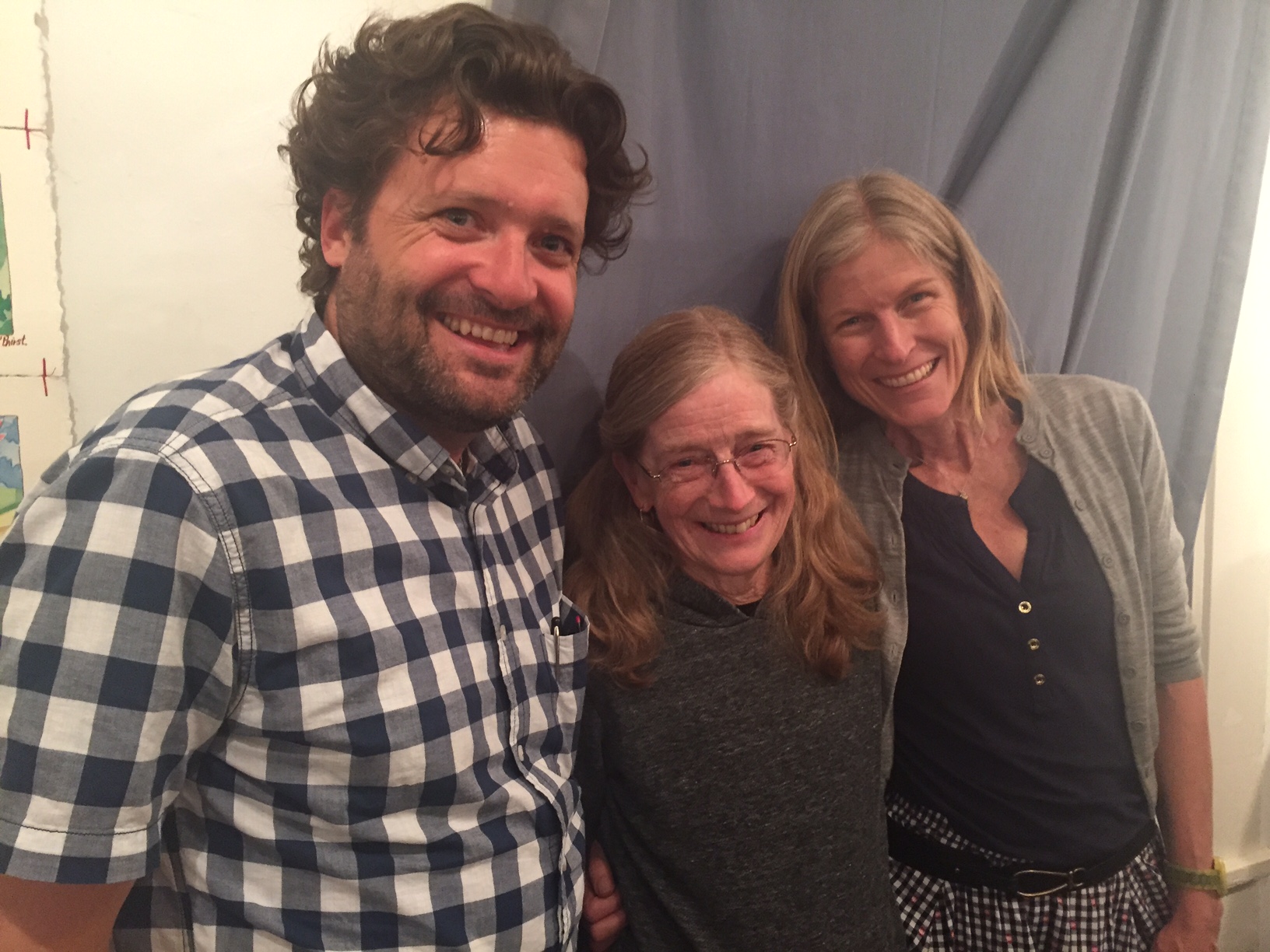
P.P.S. Here is a photo of me, my old friend, Lisa, and our kindergarten teacher.
Safety in Awareness
Friday, May 27th, 2016
This weekend many of us gathered for a Safe Church training. A friend of Ben’s, Jane Odell, led it and did a wonderful job presenting some quite unpleasant materials. We saw video testimonies of people who had been victims of abuse, as well as testimonies from ex-abusers, who explained how they used the safety and trust of a church to gain access to children whom they abused. We will need to study and design ways to make sure our church is safeguarded against any access like that. Looking at the worst-case scenarios is grim but it can teach us a lot.
But we have a lot to learn and do, and not all of it has to do with worst-case scenarios. Education and awareness are important at every step. For example, we talked about inappropriate boundary-crossing, both on the level of physical boundaries and social/relational boundaries. This could be as simple as an adult tickling or hugging a child who doesn’t want to be tickled or hugged, and as unobtrusive as showering an insecure teen with compliments and flattery. I would like to see our congregation as a place where people know they can’t cross a child’s boundaries, and where children know their boundaries and know they will be respected.
Children and teens are vulnerable first because they don’t fully understand the world, themselves, and others… but they are also vulnerable because they tend to be obedient. They live in a world where it is usually right to do what an adult asks you to do. How are they to understand when someone breaks that trust, and asks them to do something that is not right?
Just to keep this example as everyday and simple as possible, let’s imagine that you watch someone at church hugging a kid who clearly doesn’t want that hug. Imagine their body language is saying “ugh” but they are giving an awkward hug back, because they haven’t learned yet that sometimes it’s OK not to do what an adult asks. Small as it may be, this kind of interaction is echoed again and again in abusive relationships. In a situation like this, it’s totally appropriate for anyone to offer some public or private commentary, whether to the adult: “that looked awkward. Maybe she didn’t want the hug…” or to the child, “that looked awkward. It’s OK if you don’t want to hug someone.”
This tiny conversation will be important in a few big ways. First off, having eyes opened and attuned to small warning signs like this can be a way to ward off any would-be abusers who will see that nobody will turn a blind eye to them. Secondly, the children of our community need to learn that their bodies belong to them, and this secure knowledge will strengthen them to reject and/or report any attempts at abuse.
I hope our congregation can be a place that is truly safe, where children can learn to trust a wider group of people, and know that they are respected. I know this is heavy and difficult material to talk about, but it is our sacred duty to take care of the children entrusted to us, and we can do it together.
Every Blessing,
Talitha
Is the Calendar Half Full or Half Empty?
Friday, May 27th, 2016
Dear Friends,
On Tuesday afternoon, just before I sat down to write my weekly column for Contact a group of MPC folks got together to look at the church calendar for the next year, and I have come away from that meeting with some good news and some bad news for the Montclair Presbyterian Church family.
I’ll start with the bad news: the calendar is amazingly full. This is a challenge because a lot of us have things we want to do at the same time, and no one could possibly attend every event, class, concert, training, or party that’s happening in the life of our congregation. A look at the calendar can feel a bit overwhelming.
Now for the good news: the calendar is amazingly full. Our congregation is full of life. We are bursting with energy. We growing so fast, the calendar feels like an old pair of Toughskins that no longer snap around the waist, which can feel uncomfortable, but the discomfort is a sign of growth, which, in turn, is a sign of health. As hard as it is to accommodate all the events our church members want on the calendar, it is a problem I love. From where I sit, the good of a full calendar far outweighs the bad.
Thank you for being an active church with a full calendar. I love the energy, creativity, and joy I feel in our congregation.
Warmly,
Ben
Hold On to the Light
Wednesday, May 18th, 2016
This week in our Faith Exploration Program – a small group of high school students that meets before Youth Group – we focused on how to read the Bible with our brains booted up. I asked the participants to bring two Bible verses with them: one they found to be beautiful, good, true, or helpful, and one they found to be ugly, bad, false, or unhelpful.
One girl brought a verse from Numbers, needing no explanation for why she found it unhelpful – it was a description of what animals must be sacrificed (and how) to atone for the sin of the people. Bloody yuck.
Another girl in the group brought not just an unhelpful verse, but an unhelpful story: the story of Adam and Eve in the Garden of Eden, eating of the fruit of the knowledge of good and evil. Her question was: why do people focus on this story so much? How did this moralizing tale of sin and punishment become the foundation that everyone focuses on (from the apostle Paul through medieval artists and on up to today’s popular Christianity)… when for two whole chapters before that, everything was goodness and light, balance and order, and all the beauty that God created? Why did the sin-story overpower the light-story?
Indeed. Why?
Now, to be fair, I’ll say that we at MPC do a relatively good job of de-emphasizing it, skipping lightly over the sin and punishment bits. In fact our Godly Play classroom did not even have the Adam and Eve story until last year when we added it as a second Creation option for the older students. So from the nursery on up through 3rd grade our MPC children might hear nothing of creation except the brightly colored panels announcing “God created… and it was good” seven times over. But as they get a little older they hear the other story, and of course they face the Real World, with all of art history, and popular religion around them. They read the Bible for themselves and they find the book of Numbers, with all its blood and guts, and the prophets who plead with them to repent of their wicked ways. They visit other churches – our close or distant cousins in the same Christian family – and we cannot hide any longer from the fact that our religion has handed down to us the dubious gift of a strong emphasis on sin.
In situations like these I am happy that our Bible is not a blueprint, an instruction manual, or a systematic theology. No, our Bible is a collection of stories and writings, and in many ways they disagree with one another. Therefore, we must be free to disagree with them too. We are free to prefer one part over another, and we are free to wrestle angrily with the bits we can’t stand. But we don’t walk away entirely, and hopefully we don’t give up on it. Instead we “hold on to what is good,” and we remember those opening two chapters of Creation that were all light and beauty. And we don’t do it alone. Together we work through these puzzles.
Every Blessing,
Talitha