Author Archive

Join Us for Pentecost Sunday!

Thursday, May 21st, 2015

View just this post

PENTECOST SUNDAY
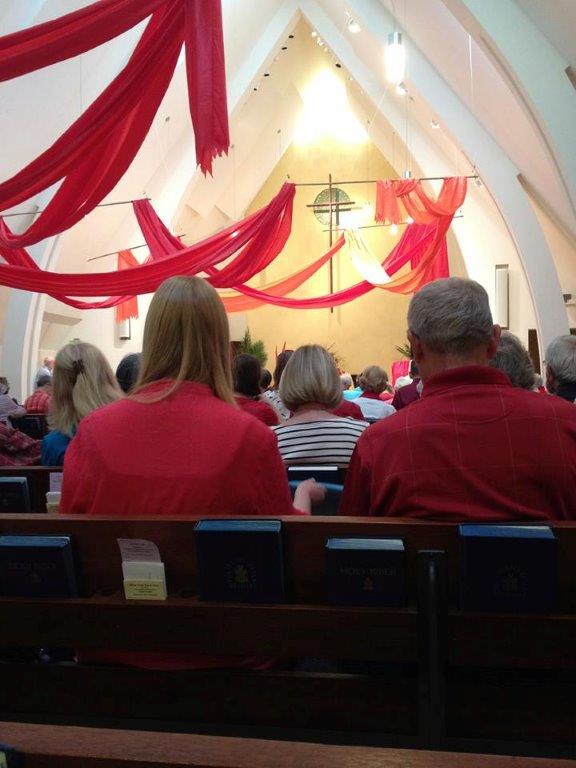
The joyful holiday often called “the birthday of the church,” Pentecost is this Sunday May 24th! On it we celebrate the Holy Spirit’s presence in and among us, uniting all nations and all peoples on earth. How do we celebrate Pentecost? It’s blessedly simple as the holiday has, thankfully, never gotten commercialized. Just show up for church — and wear red! See you Sunday at 10 AM.

pentecost


Earth Care Sunday

Sunday, May 17th, 2015

View just this post

Guest preacher Abby Mohaupt calls our attention to the earth’s dire environmental status, but also challenges us to remember the principles of our faith: the world is broken but fixable through the grace of God, so we must remain hopeful and keep working to save it.


Mayim, Mayim (“Water, Water”)

Sunday, May 17th, 2015

View just this post

Israeli folk song by E. Amiran
Arranged by Valerie Shields


Bicycle Races: a Sport for Patient Fans (and Cowbells)

Thursday, May 14th, 2015

View just this post

“Some Thoughts on Bicycle Races, Machines and the Self (Without Too Much of an Apology to Robert M. Pirsig, Whose Book on Motorcycles, the Machine and the Self, I Didn’t Understand Enough to Like Much)”

Note: sometimes I use my space in Contact as a way of writing about important issues in the life of the church. This is not one of those times. This week I’m just writing for fun.

Here’s a confession: I’m a closet fan of professional bicycle racing. I realize that as confessions go, this one is hardly a bombshell—it is (ahem) racy, but not in such a way that any kind of scandal will arise from it. This is a confession because cycling is not the kind of sport to which American Males ordinarily are expected to pay much attention. For one thing, in cycling the athlete with the strongest legs, the greatest tenacity, the truest grit—and here I’m talking about the racer who is the fastest climber of mountains—is rewarded by getting to wear a polka-dotted spandex shirt. And while the play is aggressive, and sometimes really dangerous, the sport is not violent and the machines involved aren’t nearly as testosterone-infused as are the vehicles used in NASCAR races.

I rather doubt many men retreat to man-caves to watch the Tour de France, but that’s why I like the sport. The very best way to watch a bike race is to take a picnic, find a beautiful spot along the race’s route and share a meal with friends (note the price tag—or lack thereof). Often complete strangers sitting next to each other share the contents of their picnic baskets and become friends, joyfully ringing cowbells together as the racers zip by (rather than doing a wave or giving and receiving high fives, those who watch bicycle racing—for reasons I cannot really explain—ring cowbells). Lead me not into the man-cave with its big screen and its eau de guy. Instead, give me a field of lupines and poppies, a blanket, a lovely baguette, a wedge of soft cheese, a bottle of wine, a blue sky, a cowbell and good companions.

This year is maybe only the second year in the last decade that I have not watched the Tour of California in such a manner, and I’m sorry to miss it. More often than not, the Tour went right by the front of my church in San José (My former church sits on the base of Mount Hamilton, on the way to Sierra Road both of which are among international bicycle racing’s most important North American climbs); maybe next year the tour will come through Oakland. I think Skyline would make a fine route for a race.

Last weekend two of the sport’s biggest events—the Giro d’Italia and the Tour of California got underway, and over the years I’ve noticed that during the roughly two and a half months that span the start of the Giro d’Italia and the end of Tour de France the average value of the bikes I see out on the roads here in California trends up significantly. When the big races are happening fans of the sport tend to go out and purchase racing bikes or they dust off the neglected racing bikes they already own. They dress in outfits that cost more than a Brooks Brother’s suit, and they hit the hills, their equipment functioning as an expression of their love for the sport and perhaps as tangible extensions of their fantasies, in which they are members of the world’s cycling elite, maneuvering in the peleton, preparing to break away from the pack while ascending the Alpe d’Huez.

I have a great deal of respect for those for whom equipment is a means of self-expression. I ride a bike that I put together as an exercise in self-disclosure (see photo below), and I’d never trust a carpenter, mechanic or plumber whose tools weren’t an extension of his or her self-identity. But sometimes, when the association of person and equipment becomes too close, an inversion can occur such that we become extensions of our machines. We organize our lives around what’s on TV, we go into debt so that we can have an up-to-date computer, our smart phones capture our gaze and hold our attention, even when surrounded by beauty and in the presence of loved-ones. When our equipment defines us (rather than the other way around), then our stuff becomes a source of impatience—our car will never be quite nice enough, our bike will not be new enough, and our electronics never will be quite in vogue, and we long for everything that is new so that we will be defined by that newness.

Here is another reason to love bicycle races: it is a sport for patient fans. To watch a race live is only to see—at best—a quarter of a mile in a day of riding that could cover as much as 150 miles. It might be the most boring quarter of a mile, or it might be the most exciting—one never knows—and the amount of time one actually spends looking at professional athletes on bikes can be rather short, so the fan of cycling ends up cheering for the wine and the cheese and the bread. The poppies and the lupine are the true champions and the enjoyment of time with friends cause a fan to ring a cowbell with reckless abandon. An attentive and patient fan of cycling will see that the greatest gifts of the sport have little to do with expensive accouterment; rather, by inviting its fans to us to spend hours in happy, lazy anticipation, waiting for the peleton, the sport of professional cycling’s greatest gift may not be in the speed required to compete but in the slowness necessary for those who would be spectators.

Ben
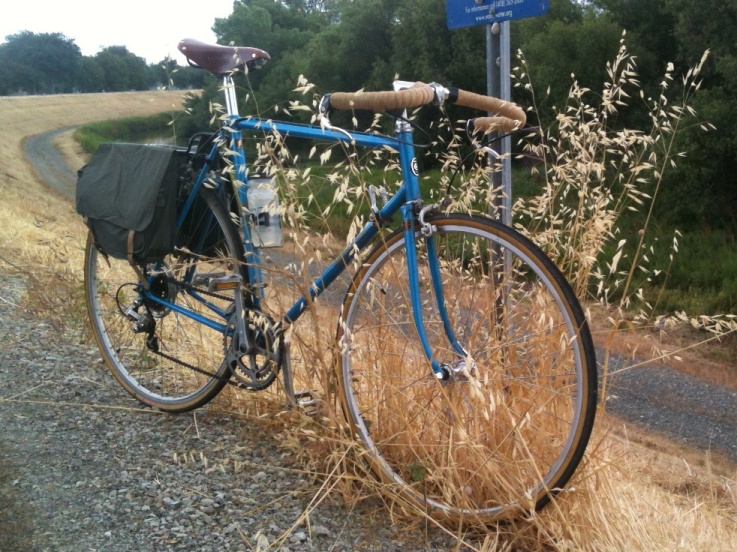
5.13.2015 Ben Bicycle


Brainstorming An Idea

Thursday, May 14th, 2015

View just this post

Friends, I’ve got an idea to share with you. I can’t really say how this idea started or who planted the first seeds of its growth – it seems to have come from many directions simultaneously – but I keep getting those spiritual nudges that seem to indicate its time has come. The idea is to add another weekly gathering into our rich mix of activities here at MPC: an opportunity for fellowship and food, intergenerational relationship-building, and learning with and from one another.

Here is my vision of it so far. On Wednesday nights we would gather in the Family Room for dinner. We would take turns preparing a simple dinner so that most of the participants could just show up, blessedly empty-handed, ready to be fed. Families with children would share tables with teenagers and adults, like we do at Family Hour, mixing amongst one another for the meal. Then after the meal we would separate by age into groups for an informal Bible study. There would be a play group for the littlest ones in the children’s corner, a children’s bible study group at a table in another corner, one table for teens, and one for adults. Each table’s Bible Study would be led by rotating volunteers and could include simple discussion, Q&A quiz games, art projects or prayer responses, text-inspired poetry, or any number of ways to interact with the text. On the third Wednesday of the month we have Taizé, so on those days we would have dinner beforehand and join in the Taizé service.

There are plenty of details and what-ifs we could stress out about, but right now I am in the excitement phase and I hope you can join me there. To me it seems like a great opportunity to increase our fellowship and friendship, to get to know one another more, and to support our learning and faith exploration. What is more, two children and one youth have told me specifically that they want MORE help in learning how to read the Bible, and heaven help us if we do not try to answer that call!

It seems that a trial period would be a good idea, so I am aiming for 6-8 weeks of Wednesday nights in the fall. We will want “critical mass” of enough people committing to it, so while we will save the actual sign-ups for later, please do reach out to me and let me know if you are interested. Or, come to the open meeting of Children & Youth Education Committee (see below – this week before church), where this will be one of the items we discuss.

Every Blessing,
Talitha


How Lovely Are The Messengers

Sunday, May 10th, 2015

View just this post

By Felix Mendelssohn
Marcia Roy, Organ


The Complications of Love

Sunday, May 10th, 2015

View just this post

Rev. Ben Daniel discusses the foundations of faith: how the basis should be ‘love one another’ as opposed to specific doctrine, and how it’s possible to rebuild your personal foundation if you find that it’s standing on anything other than love.


Mother’s Day Can Be Painful

Thursday, May 7th, 2015

View just this post

Friends,

Last year a few of you noticed something that often has confused members of the churches I’ve served: as a pastor I don’t make a big deal about Mothers’ Day. I know that my approach to the second Sunday of May can cause disappointment, in fact, one of the very few times anyone at MPC has been angry with me was a year ago when, as always, I downplayed mother’s day in celebration.

Like many Americans, I grew up in a church where Mothers’ Day was a big deal. Children gave carnations to all the mothers who walked through the door; and there were bouquets for mothers who excelled in various categories, such as being the mother with the most descendants or the mother with the youngest child. The mothers of the church would show up, all dressed up (sometimes there were big hats involved) and worship felt a little bit like a party. In my church growing up–as in many American Churches–Mothers’ Day was one of the biggest Sundays of year.

It was fun, and I continued the practice of making a big deal of Mothers’ Day through the first few years of my ministry, but then something happened that changed my life and my pastoral approach to Mothers’ Day (and Fathers’ Day): Anne and I found ourselves unable to have children. Not only were we unable to conceive in the same way that most human beings conceive, but we spent an ungodly amount of time, energy, and money trying to get pregnant using variety of medical procedures, none of which worked.

Those were difficult years, a season of my life marked by sorrow, a time when I had to drag myself into worship on the second Sundays of May and June, when Mothers and Fathers were feted and the gnawing sadness of infertility grew to an intensity I scarcely could abide. Of course a lot has changed for me since then. Anne and I adopted two children and then, in a surprise from which I’m still recovering, we ended up with a biological child as well. Our lives are now as filled with children as they are abounding in happiness and gratitude for our brood. But I still remember the painful sorrow of infertility, and I cannot lead a worship service that spends overly much time celebrating Mothers’ Day.

Over the years a few people in my congregations have been disappointed in my decision to abandon traditional celebrations of Mothers’ Day, but along the way I’ve discovered that a lot of people struggle with the way so many churches observe Mothers’ Day, and quite a few people have expressed gratitude to me for keeping Mothers’ Day low key–some because they were infertile, some because they were single, LGBT, or both, some because they had strained relationships with their mothers. It turns out that minimizing Mothers’ Day is one way churches can practice radical inclusion.

So when you come to celebration on Sunday, Mothers’ Day will be acknowledged. We’ll wish each other happiness and we’ll hear about what our Youth Group is doing to support mothers in need here in Oakland. But out of respect for those who grieve on Mothers’ Day, we’ll keep our observance of the day fairly minimal.

Thank you for your understanding and for your ongoing desire to be a welcoming and safe church.

Peace,
Ben


Thank You!

Thursday, May 7th, 2015

View just this post

Thank you, thank you, thank you for your ringing endorsement of my ministry here at Montclair, and for calling me to be your Associate Pastor! I count myself lucky to be working for such a generous-hearted and enthusiastic congregation. And I am so grateful to those who through their time and service (and a great deal of patience) have moved this process forward, especially Ben, members of MPC session, Monte McClain, and above all the APNC committee members. Thank you!

Some of you have asked when you can call me Rev., and once I again I get to tell you to hold your horses. We are to move through the process without undue delay, but summer is a-coming in, and even the faithful of our congregations and presbyteries do scatter like sheep when school gets out. I will be examined at the San Francisco Presbytery meeting on June 9th, and then will make arrangements with the Presbytery of New York City for an ordination service, which will take a few more weeks. That puts us in July, which is pretty miserable in NYC, so we’re hoping for an August ordination, followed by an August or September installation service at MPC.

I promised some details on what actually changes when I get ordained. The short answer, as you may know, is “not much,” at least in terms of how I spend my time and energy. But one important change was in my mind this past Sunday as I stood at the communion table with Ben. The words and prayers that surround the communion service are shared by pastors and congregation alike. But the central words, the “words of Institution,” which mark the meal as Communion, are reserved for pastors to say: those who have been ordained or specially commissioned for the task. Likewise with baptisms, I may say the prayer over the water or preach a sermon about baptism, but not do the act itself. So after I am ordained, I will take my turn in standing in that central position behind the table, and lifting the bread and cup. I will baptize people, or more realistically, will fight with Ben over who gets the great joy of baptizing people, and we’ll settle on alternating between the two of us. To take part in these beautiful and sacred acts is an honor and a privilege that we do not take lightly. While I recognize the wisdom of other churches who allow congregation members to officiate at the sacraments, I also appreciate the wisdom of our Presbyterian tradition: the holy task of ministering in Christ’s name may easily be done in T-shirts and blue jeans, but never without careful intention and discernment of God’s call.

One thing I love about MPC is knowing that I can make serious statements about the importance of tradition, responsibility, reverence etc., without worrying that you will take them too far and become complacent in tradition. Our congregation loves to turn the tables over, to smash idols and turn the moneychangers out of the temple… and so I can speak gently of the importance, sometimes, of respecting tradition and doing things in an orderly fashion… knowing that you will remain absolutely ready to break the rules and shake things up when it is needed. For this I thank you.

Every Blessing,
Talitha


Am I Welcome Here?

Sunday, May 3rd, 2015

View just this post

In her candidate sermon, Talitha Phillips unpacks the story of Philip and the Ethiopian eunuch, drawing out its message of absolute welcome to all who follow their hearts to God.