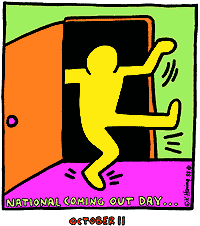
 In honor of National Coming Out Day (NCOD), here’s a portion of a chapter from my doctoral thesis, Bringing the Refugees Home: Faith Formation for the Dechurched. This chapter chronicles some of my own history with HIV/AIDS and my participation in creating the very first National Coming Out Day back in 1988.
For my friends who do not identify as LGBTQQI or as any sort of sexual minority, “coming out” as whoever you are wherever you are is a gift. Silence is deadly. And if there is anything to be learned from those of us who have had to come out as lesbian, gay, liberal, christian, atheist, presbyterian or whatever seems to be unpopular amongt your friends and colleagues, I encourage you to, as we wrote in that first NCOD brochure to “take your next step” towards being fully who you are, everywhere you go.
Silence Still Equals Death
Back in 1987, posters, buttons, and t-shirts featuring a pink triangle on a black background with the words “Silence Equals Death” began appearing in “gay ghettos”[1] throughout the U.S. Soon this became the slogan and rallying cry for ACT-UP (AIDS Coalition to Unleash Power) a direct-action political group that staged massive demonstrations, marches, rallies, and “die-ins”[2] to call attention to the plague of HIV/AIDS. As the disease ravaged the gay community, the silence of the Reagan Administration was appalling. Reagan never uttered the word publicly until 1987, even though the disease had first been identified in 1981. [3] By the time he finally said the word “AIDS” in public, almost 20,000 Americans were dead, hundreds of thousands were infected, and a global pandemic was underway.[4]
While serving as a community-based chaplain serving women and families living with HIV/AIDS in the late 90’s, I attended the first AIDS and Religion in America Conference held at the Carter Center in Atlanta in 1998[5], I sat in dumfounded grief as a researcher from the Centers for Disease Control (CDC) showed a series of slides documenting infection rates in the 80’s in the U.S., Australia and Switzerland. In Australia and Switzerland, aggressive education campaigns, easy access to condoms, and clean needles kept the epidemic in check and caused new infections to almost flat line. These countries recognized HIV as a public health emergency and reacted accordingly.
But in the U.S., where people with AIDS were stigmatized and there was no public health response from the federal government, infection rates have continued to rise and the virus has moved into more communities. As I looked at the presentation, I realized that almost everyone woman I had ever worked with had been infected in large part due to the failure of the Reagan administration to respond. Ironically, this was the first conference where folks from more conservative religious organizations such as the Salvation Army and the Southern Baptist Convention had ever shown up. There is so much HIV-infected blood on the hands of Reagan and all his friends in the religious right.
Most activists surmised that Reagan’s silence was only broken when it was made public that his longtime friend, the actor Rock Hudson had died from AIDS. It is harder to stereotype and ignore someone, or a whole group of people, when you discover that one of “them” is a member of your family or circle of friends. Pollsters often report that support for gay rights is directly correlated to knowing a gay or lesbian person.[6]
To those of us who were valiantly trying to stem the tide of new infections and to ease the isolation and suffering of the dying, it was obvious that silence about the virus was deadly. Routes of infection needed to be discussed with candor. Everyone needed to have accurate information to assess his or her own risk for contracting the virus. Those already infected needed compassion, not derision from their families, friends, and the wider community.
Reagan’s silence was deadly too because his friends in the religious right were anything but silent. Pat Buchanan, Reagan’s communication director, pronounced that AIDS is “nature’s revenge on gay men” while the Rev. Jerry Falwell went a step further and claimed that “AIDS is the wrath of God upon homosexuals.” [7] Each one of these public falsehoods and blame-filled statements led to complacency among heterosexuals at-risk and hideous shame for gay men that drove many deeper into the closet or “on the downlow”.[8]
The “outing” of Rock Hudson also made it obvious that closets were deadly too. And so, in 1988, National Gay Rights Advocates (NGRA) launched the first National Coming Out Day. As a desktop publisher and feminist activist in Los Angeles, I was hired by Jean O’Leary, executive director of the NGRA to help design and produce materials for the campaign. The artist Keith Haring had designed a beautiful cartoon of a gender-ambiguous character stepping out of a closet and we designed the “Take Your Next Step” campaign to flesh out the cartoon. In those days, the process of coming out was still fraught with difficulty that could lead to the loss of a job, housing, family, and of course, a church or other religious community. It was a fearful and dreadful time to come out, but with AIDS outing and killing people right and left, it was necessary.
In the brochure, we suggested lots of “steps” for coming out such as “look in the mirror and admit that you are gay or lesbian” or “tell your best friend that you’re gay”. I have racked my brain and looked for those old brochures without success to see if we even suggested “coming out to your pastor or church”. I don’t think we did. It was just too radical a step to imagine in 1988. Instead we suggested things like “tell the check-out lady at the grocery store that you’re a lesbian”. Jean O’Leary summed it up well: “Our invisibility is the essence of our oppression. And until we eliminate that invisibility, people are going to be able to perpetuate the lies and myths about gay people.” [9] Right-wing preachers were erasing the humanity of lgbt people because too many of us were not telling our stories for ourselves.
Silence still equals death for those who are oppressed and suffering. Even if a deadly virus is not involved, invisibility and silence are soul killers. The founder of City of Refuge, San Francisco (now City of Refuge, Oakland) Bishop Yvette A. Flunder writes,
I have found that it is of vital importance that people who have been silent and silenced far too long be given an opportunity to give voice to their struggle. Secrets kill and silence often equals death. People often speak forth the answers to their own issues as they talk it out in a supportive environment. It also has a purgative effect on the teller of the story. Shadows are not longer threatening when the light shines on them; when the secret is exposed, the demon is uncovered and rendered powerless.[10]
From the pulpit, Flunder says it more like this: “first you discover you are welcome. Really welcome. Then you tell your story – you tell everything you have ever done. And then they love you anyway. That is how you get free!” [11]
[1] Places where a high concentration of lgbt choose to live and/or congregate such as these three that I know best: West Hollywood in Los Angeles; the Castro in San Francisco; Greenwich Village in New York and Montrose in Houston. http://www.urbandictionary.com/define.php?term=gay%20ghetto (accessed December 6, 2011)
[2] All over America we laid down in front of government buildings and various other venues and traced around our bodies with red chalk or water-based red paint leaving our “outlines” to remind people of the massive death toll due to HIV/AIDS.
[3] Allen White “Reagan’s AIDS Legacy/Silence Equals Death”, sfgate.com, June 08, 2004, accessed November 28, 2011.
[4] http://www.cdc.gov/mmwr/preview/mmwrhtml/00001896.htm (accessed November 28, 2011)
[5] http://www.wfn.org/1998/11/msg00216.html (accessed November 29, 2011)
[6] http://www.gallup.com/poll/118931/knowing-someone-gay-lesbian-affects-views-gay-issues.aspx (accessed November 28, 2011)
[7] Allen White, sfgate.com
[9] http://www.brainyquote.com/quotes/authors/j/jean_oleary.html#ixzz1f1kujtwl (accessed November 29, 2011)
[10] Yvette A. Flunder. Where the Edge Gathers: Building a Community of Radical Inclusion. Cleveland: The Pilgrim Press, 2005, pg. 39.


 Update: Michael Chabon’s talk — most of it, anyway — is available for download in mp3 format. Download/listen to it now Sorry to say, we weren’t able to record the last 5 minutes.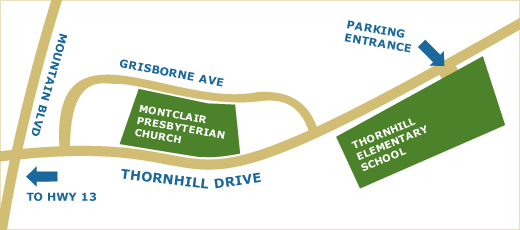

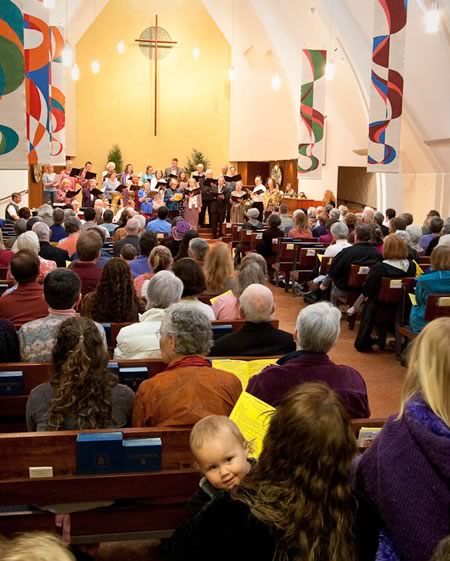

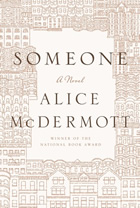 Tuesday, October 8th at 7pm, award-winning author Alice McDermott will be at MPC discussing her new book Someone. This book, her first novel since the Pulitzer Prize-nominated After This, is a an extraordinary story detailing the joys and pains of an ordinary woman’s life. We hope you will join us for what is sure to be a fascinating evening.