
By Robert Robinson
Performed by the MPC Choir
Podcast (music-samples): Play in new window | Download

Monday, September 15th, 2014
By Robert Robinson
Performed by the MPC Choir
Podcast (music-samples): Play in new window | Download
Sunday, September 7th, 2014
Rev. Ben Daniel discusses the various interpretations of Jesus’ welcoming of children (Matthew 18:1-5): as a reminder of the purity of childhood, or of the humble position children hold in the world, or as a reminder to welcome children into our midst and into worship.
Podcast: Play in new window | Download
Sunday, September 7th, 2014
By Charles Strouse
Megan McKiernan, soprano
Steve McKiernan, tenor
Kim Rankin, piano
Podcast (music-samples): Play in new window | Download
Sunday, September 7th, 2014
From “Into the Woods” by Stephen Sondheim
Megan McKiernan, soprano
Steve McKiernan, tenor
Kim Rankin, piano
Podcast (music-samples): Play in new window | Download
Thursday, September 4th, 2014
Friends,
The immigration crisis that involves people fleeing violence in Central America to find safety in the United States has reached the East Bay’s Presbyterian community.
Primera Iglesia Presbyteriana is a Spanish-Language Presbyterian congregation that worships on High Street in East Oakland. In recent months they have been joined by several Central American families in need of protection and, possibly, sanctuary. Primera Iglesia Presbyteriana is a small congregation operating on a serious shortage of funds. They need help providing care for the refugee families now worshiping with them, and they’ve reached out to several English Language churches for help, including ours.
Specifically, Primera Iglesia has asked us to enter into a covenantal relationship with the Ordoñez family–which consists of two parents, three children and a grandchild. I’ve met with the family and I’ve heard their story, and while I won’t go into details (it’s their story, after all and not mine), I will say this: I’ve been involved in working with refugees form Central America since the days when the Reagan Administration was funding the Nicaraguan Contras with ill-gotten funds. I’ve met hundreds of Central American refugees and I’ve heard dozens of stories, and this story was among the most horrific I’ve encountered. If anyone needs assistance and sanctuary, it is this family.
On Tuesday night the Session agreed to enter into a relationship with this family. We don’t yet know what that means for us–it may mean that we take up special offerings to help cover some of their legal bills; it may mean helping the family navigate and negotiate the Oakland Unified School district. Eventually, if things don’t go well with the family’s legal process, we may face the choice of extending an offer of sanctuary, but we hope that won’t be necessary.
Thankfully, this family’s case is before an immigration judge, and we hope the court will find in their favor, granting them asylum and, therefore, legal status in the United States. If that happens, our official relationship with the family will be short-lived, but I surely know our friendships with them will endure long.
Montclair Presbyterian Church has provided sanctuary for Central America Refugees in the past; during the Viet Nam war you guarded a conscientious objector. Now God is calling us to provide hospitality to a Honduran family in need. I am grateful to be part of a congregation so willing to care for God’s children.
God’s Peace,
Ben
Wednesday, August 27th, 2014
Some of you have asked more about my ordination process, so I want to update you. I am really thrilled about the outpouring of support for my ministry here and I do appreciate that many of you are eager to see the process completed. I love working here and look forward to solidifying a long-term arrangement. However, as we are Presbyterians we operate according to our church’s favorite Bible verse, I Cor. 14:40: “All things should be done decently and in order.” At times our polity may seem slow, onerous or even redundant… but Presbyterian polity provides many important checks and balances to prevent abuse of power.
Amidst the flood of horrific news stories in the past few weeks many of you probably missed the story about the struggle at Mars Hill Church in Seattle, a member of the Acts 29 evangelical church network (note: not Presbyterian!). Various complaints were being filed over the years regarding the head pastor Mark Driscoll’s manipulative and coercive leadership style, including his methods of excommunicating and shunning members who disagreed with him. Finally his deception and coercion (not to mention misogyny and bullying) have caught up with him to the point that last week Acts 29 removed Mars Hill from membership in the network, and publically stated that Driscoll needs to receive help and to be removed from the pulpit.
I would not want to gloat over another church’s misfortune but we certainly can learn from it. In the Presbyterian Church (PCUSA) we have many systems of accountability that work against such abuses. Pastors are not bosses here, but are accountable to Session and to the local Presbytery. Even the most “powerful” person in our church – the Moderator of General Assembly – is merely a servant of making things run smoothly at the largest committee meeting we have. And while hiring a non-ordained staff member is an act of the congregation, ordination as Teaching Elder (pastor) is an act of the local Presbytery, and pastors are members of Presbytery rather than the congregation. So the circle of discernment is wider… and so is our accountability.
My ordination process is twofold. Much of it has already taken place under the auspices of the New York City Presbytery, where I discerned God’s call to ministry and was supported through my seminary years, internship, several examinations, and other requirements. From my initial desire to be a mission co-worker in Africa, to wanting in short succession to be a seminary professor, then a rural pastor, then a pediatric hospital chaplain, they helped me sort through God’s call and my many adventures on the way. That committee certified me as a “Candidate ready to receive a call” also known as “all but call” or ABC – meaning that I can be ordained as soon as a church calls me to a Pastor position with the agreement of a local Presbytery. The “call” process is now going into the hands of the San Francisco Presbytery. They will work with MPC to fulfill the requirements for calling a pastor – similar to the PNC that called Ben, with the additional requirement that the members of Presbytery also interview and examine the candidate when a new ordination is involved. By the way, an Associate Pastor’s job duties may not be very different from mine as Coordinator for Children, Youth, and Family Life. The main difference is that an Associate Pastor celebrates the Sacraments (communion and baptism), and has voice and vote privileges in Presbytery.
So I’d like to invite you to see it as a spiritual process along with me. Some of you may feel certain already that you would like me to be an Associate Pastor, but we will not rush ahead until our whole circle of accountability feels ready. This may include an update of our Mission Study, considering other candidates, and meetings with the local Committee on Ministry. Together we can let God’s spirit guide us through the process.
Every Blessing,
Talitha
Wednesday, August 27th, 2014
Friends,
At the end of June I wrote in this column about the positive experience I had walking thought East Oakland with an ecumenical group of people who long for peace and economic prosperity in our city’s poorest neighborhoods. The walk symbolized our commitment to build relationships with and to work alongside our neighbors who live in Oakland’s lower elevations.
I’ll be heading back down to the East Oakland this Friday evening to walk again and this time the walk will take on more urgency. In June I had never heard of Ferguson, Missouri. I knew about police brutality, I knew about economic inequality, and I knew about media double standards when talking about race. The murder of Trayvon Martin had a profound impact on me, and because I spent the last ten years living in an economically-disadvantaged predominantly Hispanic neighborhood in San Jose, I had–perhaps more than most White America Males–a sense for the ways people in communities of color are excluded from the American dream.
But Ferguson has changed things for me. I was not prepared to see a militarized police force gas, harass, and arrest members of the press. It turns out we live in a nation where pointing a camera in the general direction of economic and social injustice–thought not a crime–can get you arrested, and when journalists no longer are free to visit and report upon disadvantaged communities, it becomes our responsibility to go see for ourselves. This is not to say that I expect to walk through a riot, but if the unrest manifest in Ferguson spreads to Oakland, I want to be able to say that the people most profoundly affected are people with whom I have walked, with whom I’ve shared a neighborly conversation, and with whom I have worked for our city’s common good.
I hope you will join me in the walk.
God’s Peace,
Ben
Tuesday, August 5th, 2014
Why go on a mission trip? Why go to help people other places when so many need help right here? Why waste so much money on airfare and luggage? Why, why, why? I am, of course, leading our youth on a mission trip starting this Saturday morning, so you may guess that I will find ways to answer these questions. But let me begin with my fist raised indignantly in the air about those questions. They are questions that need to be asked, and badly. The short-term mission trip industry is a broken and troublesome system. Churches across America spend millions of dollars each year sending unskilled teenagers to do menial labor in distant cities and countries. One example particularly sticks in my throat, of a church in Honduras that was painted three times in one year by three visiting “mission trips” who wanted to be “helpful” but didn’t really stop to ask how they could help. A lot of stupidity has been perpetuated in the name of God’s mission. When the youth got together to talk about our preparations for Memphis, I shared with them a quote from an Aboriginal Australian activist community:
“If you have come here to help me, you are wasting our time.
If you have come here because your liberation is bound up with mine,
then let us work together.”
Some of the youth were under the impression that we are going to Memphis because we will find the neediest of the needy there. To some extent that is true, but there are lots of needy people here in Oakland too. No, we are going to Memphis because there they are doing great work that will captivate us and inspire us for the better. We are going so that we might have the privilege of joining in some of the most exciting world-changing work around. Ten years ago Memphis did not have a single farmer’s market, and these days the city is hopping with new food options, bringing vegetables into the “food deserts,” reclaiming the neighborhoods from blight to urban farms, and finding ways to turn small gardens from expensive hobbies into money-making endeavors. With farms as small as 1/4 acre, they are making a new food economy possible.
So whenever I plan a mission trip I ask — am I doing this out of a sense of guilt or am I really trying to seek the good? If we are feeling noble about ourselves rather than humble and inspired, that’s a clue that we might be on the wrong track. There is always the existential benefit that travel adds (particularly to youth) in that it gets us out of our comfort zones and ready to look, listen, and learn. That by itself is not sufficient however. We need to be honest about the fact that we are not going to dramatically change anyone else’s lives. But we may, with God’s grace, change our own.
Please wish us safe journeys and keep us in your prayers!
Every Blessing,
Talitha
Tuesday, August 5th, 2014
This week and last week I experienced a bit of a lull in my work load. Halfway between Family Camp and the Youth Mission Trip I have fewer things on my plate for a blessed moment… which means that I get to devote more of my time to one thing that is not calendar-driven: spiritual care. I am lucky to have this as part of my job – the pastoral work of visiting with you and supporting your spiritual journeys. Whether visiting someone in the hospital, or just chatting over a cup of tea, or reaching out by phone to someone who I know is having a hard time, providing spiritual care is one of the biggest joys of my work here at MPC.
What is spiritual care, anyway? It isn’t therapy (although we may feel some feelings). It isn’t social work (although we may solve a problem or two). It isn’t leadership training or crisis intervention or life coaching or church stewardship or Bible study. To me, spiritual care is the work of accompanying souls, bearing witness to that which lies under the surface, and holding it up to the light of God’s love. While we are bustling about busy with our lives, our souls may be secretly grieving… or struggling with conflict… or searching for meaning and direction… or even feeling lost. Or they may be bursting with joy, excitement, and love — and still not have the chance to express these. Take “soul” in the religious or psychological sense, but no matter how you take it, there is this deeper part of our selves that doesn’t get to come out and play very often because it’s too different from the rest of our lives. Maybe we don’t know what to do with it… maybe we’d rather not “go there.” If ever you find yourself feeling that deep inner disconnect, it’s time to look for some spiritual care. Come talk to me or Ben, or find another way through journaling or prayer. There are so many different ways of caring for our souls. My prayer for each of us today is that our souls may not feel alone.
Every Blessing,
Talitha
Sunday, July 27th, 2014
 Wednesday, September 10th at 7pm, authors Louise Greenspan, MD, and Julianna Deardorff, PhD will be at MPC discussing their new book “The New Puberty: How to Navigate Early Development in Today’s Girls”. With girls maturing earlier than ever, many parents, teachers, and family members are concerned about the reason for and impact of this change. Join authors Louise Greenspan, MD, and Julianna Deardorff, PhD as they discuss their new book, a “reassuring, empowering guide” based on original research and clinical experience. it’s sure to be a fascinating and informative evening.
A sea change is underway among many of today’s girls: They are developing faster and entering puberty earlier than ever before. Just a generation ago, fewer than 5 percent of girls started puberty before the age of 8; today that percentage has more than doubled. Why is this happening ,and what does it mean for our girls’ futures? What can we do to help lead them through this major transition to live happy and healthy lives? In their groundbreaking book, The New Puberty, Louise Greenspan, MD and Julianna Deardorff, PhD – two leading experts on the root causes and potential consequences of early puberty in girls – have written a reassuring and empowering guide that will forever change the way we view puberty and parent the next generation. Drawing on original cutting-edge research and years of clinical experience, Drs Greenspan and Deardorff explain why girls are developing earlier and identify both established and surprising triggers – from excess body fat and hormone-mimicking chemicals to emotional stressors in a girl’s home and family life. They offer highly practical strategies that can help prevent and manage early puberty. Impeccably researched, engaging, and urgently needed, The New Puberty provides a roadmap to help young girls move forward with confidence, ensuring their future well-being.
Louise Greenspan, MD, a board-certified endocrinologist focusing on puberty and an international leader in the field, works at Kaiser Permanente and is on faculty at UCSF.
Julianna Deardorff, PhD, is a clinical psychologist with a specialty in adolescence, and is on faculty at UC Berkeley.The authors’ pioneering work on a recent early puberty study won them the 2013 Community Breast Cancer Research Award. They have contributed to Time magazine, Science, New York Times Magazine, and NPR. Both have young daughters and live in the San Francisco Bay Area.
“The New Puberty is a truly important book. Without jumping to conclusions, this book shows concern without alarm, discusses the scientific factors that could be triggering it,and most important details the psychological consequences that girls might go through, and the support they need.”—Po Bronson, co-author of NurtureShock
“The New Puberty is a treasure trove of information. In it, the authors take a deep dive into the psychology and biology of teen girls. It is destined to become a classic for parents and educators.”—Louann Brizendine, MD, author of The Female Brain and founder/director of the Women’s and Teen Girl’s Mood and Hormone Clinic, UCSF
“Filled with surprising and fascinating research, as well as practical and empowering strategies, The New Puberty is a book every parent and health practitioner needs to read.”—David Kessler, author of the New York Times bestselling The End of Overeating and former commissioner of the US Food and Drug Administration
“Increasingly parents are asking why their children are heading into puberty at a much younger age than they ever did. Combining their backgrounds as both scientists and parents, Greenspan and Deardorff give them all of the answers they are looking for. The New Puberty explains why our changing world has affected our kids’ bodies—then guides parents on what they can do. Anyone who has a young girl will want to read this book!”—Cara Natterson, MD, pediatrician and New York Times bestselling author of The Care and Keeping of You 2
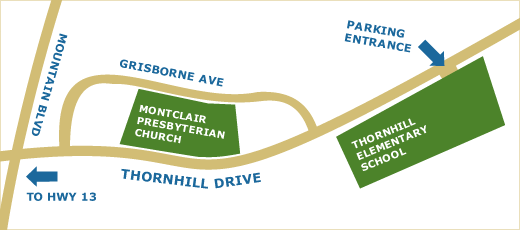
Parking will be available in the lot at nearby Thornhill Elementary School (see below); more parking info and directions info are available on MPC’s parking and directions page.
The book talk is co-sponsored by Great Good Place for Books in Montclair. You’ll have the option of purchasing the book from them right after the talk.