

Archive for the ‘Pastoral Blog’ Category

White & African Americans

Thursday, June 25th, 2015

View just this post

Since last fall’s Black Lives Matter protests here in Oakland I’ve been spending a lot of time thinking about race. In particular, I have found those voices within the African American community, who are asking White Americans to have a conversation about race to be moving and compelling, and so, as part of an ongoing conversation about race, I’d like to offer this observation: as I follow and participate in conversations about race, I find that White Americans understand racism differently than do our African American counterparts.

Most of the White Americans I know think of racism in terms of personal animosity, such that a racist is someone who hates, fears, denigrates, mistreats is unkind to, or otherwise doesn’t like Black people because they are black. It is a fact that most White Americans are mostly past such personal animosity. Most White Americans enjoy the company of and genuinely are grateful for the people in their lives who are not White. White people–by and large–have come to appreciate the beauty of human diversity and so it’s easy for White People to think racism is a really ugly and painful part of the past.

But when African Americans write and speak about racism the focus is always on structural racism. In my experience Black Americans, like their White counterparts, appreciate the increasing interpersonal goodwill that marks America’s social landscape, but that’s really not the issue. As I follow the American conversation about race, I hear African Americans talk about societal systems and institutional inertia, and political proclivities that keep African Americans poor, educationally disadvantaged, medically underserved, and vulnerable to the whims of a perniciously dysfunctional justice system.

There is nothing new about African Americans focusing upon issues of justice rather than of personal goodwill. It’s worth remembering that the Civil Rights movement was not an audition for friendship with White Americans. It was a sometimes successful attempt to change laws. It was about things like voting rights and access to public services, and equality in public education. A lot of personal animosity also was set aside as a result of the Civil Rights movement, and that has been a wonderful ancillary benefit, but it never was the main point.

Like most White Americans, I love living in a society in which people of various races increasingly are living side by side, sharing love, friendship, and neighborly good-will. For me this is not just an abstraction: my family is biracial. I don’t just like living in an America where personal racism is a dying phenomenon, I need to live in that America. But for the sake of my non-White children I also need to follow the lead of the African American community as it talks about race. I need to work for justice on a societal level, so that all God’s children will not just get along but also will thrive.

Ben

p.s. Pastor Ben will be on vacation starting Monday, June 29th through July 16th. He will not have any electronic devices with him. Contact office with any emergencies.
 

Early June

Thursday, June 11th, 2015

View just this post

The beginning of June is an interesting time of year. School is not yet out, but all the academic learning pretty much is wrapped up (at least for the children who live at my house). The apricots, peaches and nectarines look beautiful, and they’re starting to smell good, too, but they’re still hard and sour. The weather cannot decide if it’s a season of fog, or sunshine or of rain. Vacation is on the mind, but there is yet work to be done. If summer were a nap, we’d just be falling asleep, not quite awake yet, far from the deep slumber of August.

The first weeks of June are an in-between place, and such places can be unnerving because during early June the Summer is as yet only half-formed. But that which is half-formed also is half-unformed and herein lies a joyful possibility. The summer may yet be imagined into existence. Plans may yet be laid down. Hopes may become incarnate.

In June there’s still time to buy a new pair of sandals, or to discover a new author whose novel can be read on a beach we may yet arrange to visit.

And my prayer for you is this: may this early June be a time when you see past the uncertainty and into the possibility of a lovely summer. May such hope and grace be yours in every early June: those you find on your calendar and those figurative early Junes that may come along at any time of the year.

Ben


Walking Into Freedom

Wednesday, June 3rd, 2015

View just this post

This week instead of writing something new for Contact, I’m going to publish the homily I preached at my sister’s wedding in Mendocino last Saturday. I’m doing this both because I’m still on a high from the loveliness of the day and because the homily itself is a product of our congregation’s participation in the Faith Trio, and, as such, I think it is an example of how interfaith dialogue can inform our spiritual lives as individuals as a congregation.

Before preaching the homily I read from the story of the Exodus, where Moses leads the Israelites out of Egypt into the wilderness.

_____________________

Gwyneth and Sklyer, I should begin by admitting to you that the story I’ve just read to you is not particularly romantic. It’s not the kind of story anyone reads at a wedding. The story of Moses lifting his staff over the sea, causing it to split in two so that a large band of escaped slaves could pass through the water as if on dry land, is a great story about liberation and about God’s concern for the poor and downtrodden. The story was a source of hope and comfort for those freeing slavery in the American South; Martin Luther King, Oscar Romero, and Desmond Tutu all looked to this passage for inspiration as they worked to make a better, more just and peaceable word for all God’s Children, which is lovely, but what does it have to do with a wedding?

To answer that question, I’m going to make another confession: and that is I’m not going to deliver a traditional Presbyterian wedding homily. When I was in seminary I learned that a proper Presbyterian sermon or homily begins by reading the Bible and then it looks for how the words contained therein might have meaning for us today, which is what I do just about every Sunday, but for your wedding I’m not really looking for meaning in this story, at least not directly. Rather, this homily’s central metaphor comes from a Jewish tradition about this story, a midrash to which a rabbi friend of mine introduced me about ten days ago. To preach from a story not found in the Bible about a story that is found in the Bible is not exactly playing according to Hoyle (at least not for a Presbyterian), but we’re a long way from Princeton Theological Seminary, and it won’t be the first time a member of our family has dealt out hands from an offbeat, somewhat heretical deck of playing cards.

Anyway, according to this tradition, when Moses stood on the shore of the Sea of Reeds and lifted up his staff, and, expecting a miracle, commanded the waters to part, nothing happened at first… which must have been a little bit awkward. But then, according to this tradition, a man by the name of Nashon ben Aminadav walked into the sea anyway, and still nothing happened. He walked deeper and deeper and the waters stayed put until the waters reached Nashon ben Aminadav’s nose. Then the waters parted.

This, it seems to me, is a good metaphor for marriage. The wedding ceremony functions a lot like a Moses holding up his staff. There are vows, and an exchange of rings; there’s a sacred kiss and a proclamation of marriage. These are symbols that mark the next leg of your journey together, but there is no miracle, and no waters part, until you take the first step, and probably it will take several steps, and you may need to go down clear up to your nose before anything happens – but if you trust the love that has brought you to this place, and if you have confidence in the grace that makes you strong, then you can walk forward out of bondage and into freedom.

And make no mistake here. By getting married you are walking into freedom. Far too many people speak of marriage as an end to freedom, and I know that for some people marriage is a form of bondage, but it doesn’t have to be. The freed slaves who followed Nashon ben Aminadav into the sea didn’t emerge straight onto the shores of the Promised Land. It took time. They had to cross though a desert, where things were scary and often quite rough, but they also feasted on manna from heaven and they drank from springs of miraculous waters; and even when they finally did reach the Promised Land there were giants living there, and hostile neighbors. Freedom, it turns out, isn’t always easy, but it is good. Despite what you may have heard, freedom is far more than just another word for nothing left to lose.

Or at least it can be. Now I’m going to go back to being a Presbyterian and point out that in the Calvinist tradition, we understand that freedom comes in two forms. There is freedom from and freedom to. By walking away from slavery in Egypt, the children of Israel were freed from bondage, but that only got them down to the beach. By following Nashon ben Aminadav into the sea, and from there on to the Promised Land, the Children of Israel got the freedom to become a nation, freedom to live lives that nurtured the soul,

And I would say that by falling in love you have freed yourselves from the loneliness and uncertainty of single life; by walking boldly into marriage you are freeing yourselves to forge a life of mutual help and companionship together. You are freeing yourselves to build loving and nurturing home for your growing family. You are freeing yourselves to enter a grand adventure together. It’s not an easy adventure, but it is good. Manna and heavenly water await you along the way, and your destination is a promised land, but to get there you must hold hands and step into the water together, and as you do you are surrounded by our prayers, by our support and, more than anything else, by our love.

Ben


An Analogy Between Faith and Auto-Body Work

Thursday, May 28th, 2015

View just this post

And it came to pass in these latter days that both of the Pastor’s cars needed the healing attention of a body shop at the same time (in fact the Pastor wrote these very words while sitting in a rented Fiat 500L as he waited for his spouse who was finishing up her work day; a second rental car had yet to be provided and the Pastor’s family was experiencing the very First World inconvenience that is life with one car). Neither the Pastor nor the Pastor’s Wife worries too much about the appearance of their vehicles, but both cars had been on the receiving-end of damage that really needed to be fixed, and so both cars were admitted to an establishment called George V. Arth & Son, which is down by the Oakland Museum of California, on the cusp of Chinatown. George V. Arth & Son came highly recommended by Yelp and by the Pastor’s insurance company. It’s too early to report on the quality of their craftsmanship, but the people at the front desk seem to have the kind of gentle bedside manner the Pastor and his wife appreciate in those who make a living working on automobiles. What’s most interesting about George V. Arth & Son is the fact that the company has been in business and has been owned and operated by the same family since 1877.

Astute readers will note that the body shop currently in charge of fixing the Pastor’s two automobiles, has been in business since before the first modern automobiles went into production (Karl Benz started building and selling cars in 1888). George V. Arth & Son started as a wagon repair shop, but unlike most such businesses, George V. Arth & Son survived because thirty years after papa George set up shop, when Henry Ford started producing his Model T, George Jr., adapted and learned how to fix automobiles.

I don’t know when George V. Arth & Son last worked on a horse-drawn wagon (and for all I know they’d still work on one if someone asked), but I’m assuming there were several decades of transition, as cars gradually replaced wagons in the shop, but the business did change, and it has kept changing. The change from wagons to automobiles was a change from working in wood to working in steel, and in the last twenty years or so, George V. Arth & Son has had to change again as, increasingly, cars’ bumpers are made of plastic. This adaptability has allowed George V. Arth & Son to be the oldest body shop west of the Mississippi River.

There is, I think, an analogy between faith and auto-body work. In order to survive faith must be adaptable. We must be willing to change what we believe and how we believe. For example, for 90 percent of Christian history, a majority of the followers of Jesus believed slavery was an acceptable practice, but that has changed. We who are Christians also have changed our embrace of anti-Semitism, and in the United States anyway, we’ve given up on the idea that monarchs rule by Heaven’s favor.

Progressive Christianity—as it is understood by the Pastor whose cars now are subject to the tender ministrations of George V. Arth & Son—is a system of faith that embraces and seeks to understand the changes necessary for the long term survival of the faith. There’s nothing new about such an approach to theology and spirituality, in fact the two millennia of Church history are filled with examples of people who led by exploring the margins of belief, looking for the ways in which Christianity needed to change: St. Paul, for example, and the Church Fathers; Irish Monks such as St. Columba; medieval Theologians like Hildegard von Bingen and Thomas Aquinas; reformers like Marguerite de Navarre and John Calvin; abolitionists like William Wilberforce and Harriet Beecher Stowe; Neoliberals like Karl Barth, Dietrich Bonhoffer and the Brothers Niebuhr; Liberation theologians like Martin Luther King Jr., Oscar Romero, Rosa Parks, and Jane Spahr. Like George V. Arth & Son, the church has survived because it’s been able to change.

Some things don’t change, of course. The auto body shop currently healing the Pastor’s cars still fixes vehicles, and the Church remains committed to the glorification of God and to the proclamation of God’s reign of justice, compassion, peace, grace and joy in the world. Many are those who seek to understand the ways the church needs to stay the same and to focus on what doesn’t change. Their work is important and for their efforts the Pastor is grateful.

But the Pastor also is excited about understanding the ways the Church needs to change.

Ben


Pentecost Sunday

Thursday, May 21st, 2015

View just this post

Pentecost is one of my favorite days on the Church calendar. On Pentecost we remember the story of the birth of the Church, when the Holy Spirit came upon the followers of Jesus with a mighty wind and in tongues of fire, and when, having been filled with the Spirit, those same disciples went out into Jerusalem to preach with power in a variety of languages, most of which were unfamiliar to those bringing the message.

Pentecost reminds us that ours is a global faith, and Pentecost assures us that we can be filled with God’s spirit and we can be made bold even when we feel timid. I love Pentecost for its message of hope, for the ways it inspires us to recognize spiritual connections that cross boundaries of race, ethnicity, nationality and language, and because—and this is rare for a Church holy day—it has yet to be commercialized.

The MPC staff has been working together to create a wonderful celebration on Pentecost, and I hope you will join us on Sunday. I’m looking forward to it.

Meanwhile—because I’m a Calvin nerd—here’s a link to a video of the Pentecost service at Geneva’s St. Pierre cathedral that marked Calvin’s 500th birthday. The service—which starts roughly four minutes into the video—is mostly in French, but even if you don’t speak French it’s worth watching the first couple of minutes of the video so that you can see the amazing liturgical art. Also, you can see the pulpit from which Calvin preached (if, like me, you’re that kind of nerd), and you get extra points if you recognize anyone in the congregation.

Ben


Bicycle Races: a Sport for Patient Fans (and Cowbells)

Thursday, May 14th, 2015

View just this post

“Some Thoughts on Bicycle Races, Machines and the Self (Without Too Much of an Apology to Robert M. Pirsig, Whose Book on Motorcycles, the Machine and the Self, I Didn’t Understand Enough to Like Much)”

Note: sometimes I use my space in Contact as a way of writing about important issues in the life of the church. This is not one of those times. This week I’m just writing for fun.

Here’s a confession: I’m a closet fan of professional bicycle racing. I realize that as confessions go, this one is hardly a bombshell—it is (ahem) racy, but not in such a way that any kind of scandal will arise from it. This is a confession because cycling is not the kind of sport to which American Males ordinarily are expected to pay much attention. For one thing, in cycling the athlete with the strongest legs, the greatest tenacity, the truest grit—and here I’m talking about the racer who is the fastest climber of mountains—is rewarded by getting to wear a polka-dotted spandex shirt. And while the play is aggressive, and sometimes really dangerous, the sport is not violent and the machines involved aren’t nearly as testosterone-infused as are the vehicles used in NASCAR races.

I rather doubt many men retreat to man-caves to watch the Tour de France, but that’s why I like the sport. The very best way to watch a bike race is to take a picnic, find a beautiful spot along the race’s route and share a meal with friends (note the price tag—or lack thereof). Often complete strangers sitting next to each other share the contents of their picnic baskets and become friends, joyfully ringing cowbells together as the racers zip by (rather than doing a wave or giving and receiving high fives, those who watch bicycle racing—for reasons I cannot really explain—ring cowbells). Lead me not into the man-cave with its big screen and its eau de guy. Instead, give me a field of lupines and poppies, a blanket, a lovely baguette, a wedge of soft cheese, a bottle of wine, a blue sky, a cowbell and good companions.

This year is maybe only the second year in the last decade that I have not watched the Tour of California in such a manner, and I’m sorry to miss it. More often than not, the Tour went right by the front of my church in San José (My former church sits on the base of Mount Hamilton, on the way to Sierra Road both of which are among international bicycle racing’s most important North American climbs); maybe next year the tour will come through Oakland. I think Skyline would make a fine route for a race.

Last weekend two of the sport’s biggest events—the Giro d’Italia and the Tour of California got underway, and over the years I’ve noticed that during the roughly two and a half months that span the start of the Giro d’Italia and the end of Tour de France the average value of the bikes I see out on the roads here in California trends up significantly. When the big races are happening fans of the sport tend to go out and purchase racing bikes or they dust off the neglected racing bikes they already own. They dress in outfits that cost more than a Brooks Brother’s suit, and they hit the hills, their equipment functioning as an expression of their love for the sport and perhaps as tangible extensions of their fantasies, in which they are members of the world’s cycling elite, maneuvering in the peleton, preparing to break away from the pack while ascending the Alpe d’Huez.

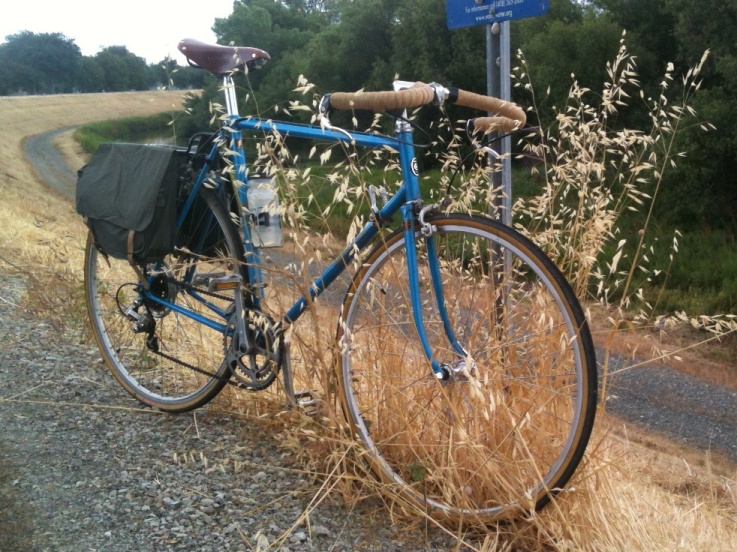
I have a great deal of respect for those for whom equipment is a means of self-expression. I ride a bike that I put together as an exercise in self-disclosure (see photo below), and I’d never trust a carpenter, mechanic or plumber whose tools weren’t an extension of his or her self-identity. But sometimes, when the association of person and equipment becomes too close, an inversion can occur such that we become extensions of our machines. We organize our lives around what’s on TV, we go into debt so that we can have an up-to-date computer, our smart phones capture our gaze and hold our attention, even when surrounded by beauty and in the presence of loved-ones. When our equipment defines us (rather than the other way around), then our stuff becomes a source of impatience—our car will never be quite nice enough, our bike will not be new enough, and our electronics never will be quite in vogue, and we long for everything that is new so that we will be defined by that newness.

Here is another reason to love bicycle races: it is a sport for patient fans. To watch a race live is only to see—at best—a quarter of a mile in a day of riding that could cover as much as 150 miles. It might be the most boring quarter of a mile, or it might be the most exciting—one never knows—and the amount of time one actually spends looking at professional athletes on bikes can be rather short, so the fan of cycling ends up cheering for the wine and the cheese and the bread. The poppies and the lupine are the true champions and the enjoyment of time with friends cause a fan to ring a cowbell with reckless abandon. An attentive and patient fan of cycling will see that the greatest gifts of the sport have little to do with expensive accouterment; rather, by inviting its fans to us to spend hours in happy, lazy anticipation, waiting for the peleton, the sport of professional cycling’s greatest gift may not be in the speed required to compete but in the slowness necessary for those who would be spectators.

Ben

5.13.2015 Ben Bicycle


Mother’s Day Can Be Painful

Thursday, May 7th, 2015

View just this post

Friends,

Last year a few of you noticed something that often has confused members of the churches I’ve served: as a pastor I don’t make a big deal about Mothers’ Day. I know that my approach to the second Sunday of May can cause disappointment, in fact, one of the very few times anyone at MPC has been angry with me was a year ago when, as always, I downplayed mother’s day in celebration.

Like many Americans, I grew up in a church where Mothers’ Day was a big deal. Children gave carnations to all the mothers who walked through the door; and there were bouquets for mothers who excelled in various categories, such as being the mother with the most descendants or the mother with the youngest child. The mothers of the church would show up, all dressed up (sometimes there were big hats involved) and worship felt a little bit like a party. In my church growing up–as in many American Churches–Mothers’ Day was one of the biggest Sundays of year.

It was fun, and I continued the practice of making a big deal of Mothers’ Day through the first few years of my ministry, but then something happened that changed my life and my pastoral approach to Mothers’ Day (and Fathers’ Day): Anne and I found ourselves unable to have children. Not only were we unable to conceive in the same way that most human beings conceive, but we spent an ungodly amount of time, energy, and money trying to get pregnant using variety of medical procedures, none of which worked.

Those were difficult years, a season of my life marked by sorrow, a time when I had to drag myself into worship on the second Sundays of May and June, when Mothers and Fathers were feted and the gnawing sadness of infertility grew to an intensity I scarcely could abide. Of course a lot has changed for me since then. Anne and I adopted two children and then, in a surprise from which I’m still recovering, we ended up with a biological child as well. Our lives are now as filled with children as they are abounding in happiness and gratitude for our brood. But I still remember the painful sorrow of infertility, and I cannot lead a worship service that spends overly much time celebrating Mothers’ Day.

Over the years a few people in my congregations have been disappointed in my decision to abandon traditional celebrations of Mothers’ Day, but along the way I’ve discovered that a lot of people struggle with the way so many churches observe Mothers’ Day, and quite a few people have expressed gratitude to me for keeping Mothers’ Day low key–some because they were infertile, some because they were single, LGBT, or both, some because they had strained relationships with their mothers. It turns out that minimizing Mothers’ Day is one way churches can practice radical inclusion.

So when you come to celebration on Sunday, Mothers’ Day will be acknowledged. We’ll wish each other happiness and we’ll hear about what our Youth Group is doing to support mothers in need here in Oakland. But out of respect for those who grieve on Mothers’ Day, we’ll keep our observance of the day fairly minimal.

Thank you for your understanding and for your ongoing desire to be a welcoming and safe church.

Peace,
Ben


Why We March

Thursday, April 30th, 2015

View just this post

Rather than write a Contact article this week, I’d like to pass along—in written form—a radio spot I heard while driving my kids to school this week. The journalist who wrote the piece is named Zaidee Stavely. Zaidee’s mother was my kindergarten teacher, my mother is Zaidee’s God-mother, and Zaidee and my sister, Anna were best friends growing up. So naturally, I’m proud of the work Zaidee is doing, but the real reason I’m recommending this radio spot to you is that when I heard it, I realized that it gave expression to why I feel it is important to go into East Oakland once a month to march in support of the Ceasefire program, an initiative that brings faith and community leaders and law enforcement together to get guns off of Oakland’s streets. Since the ceasefire program began crime has fallen in Oakland, and while I suspect our marches are the least important part of the program, still I’m happy that so many folks from MPC show up every fourth Friday. Even if our work has but a small effect, I’m glad to be part of anything that will prevent the kind of tragedy upon which Zaidee is reporting. Here’s the link.

Ben


Religious Space that Nurtures

Thursday, April 23rd, 2015

View just this post

I took a vacation last week. I didn’t leave Oakland because my kids still were in school, but the school where Anne teaches was in spring break, so I decided to take a few days off so that the two of us could do things together that the kids might not have wanted to do. So, for example, we rode our tandem bike out onto the Bay Bridge to where the bike path ends. We took public transportation to the Legion of Honor in San Francisco, and on Friday morning, while Anne took the kids to school and did some shopping, I made a micro-pilgrimage by riding my bicycle to two different holy sites in Oakland. And they couldn’t have been more different.

My first stop was a little Vietnamese Buddhist shrine located at the corner of 19th Street and 11th Avenue. This place has gotten national attention (I first heard about it on PRI) because it has a remarkable story. A few years back one of the local residents decided put a Buddha statue in the neglected and trash-strewn median at the intersection of 19th and 11th. The man was not religious, he just thought the Buddha (which he purchased at an Ace Hardware store) would look nicer than bare dirt and empty beer bottles.

But after he put the Buddha on the median a miracle happened. Vietnamese immigrants living in the neighborhood started caring for the Buddha. They painted him and erected a shelter over him. Said shelter is now outfitted with granite trim (leftover from someone’s kitchen remodel, I think). There are fresh flowers, and incense, and flags, and now the original sitting Buddha has been joined by other statues, including a reclining Buddha and Quan Yin, the Buddhist personification of compassion. The shrine is now a hub of religious activity in the neighborhood, which has experienced a drop both in crime and in litter since the installation of Buddha. It’s worth a visit. (For more information on the Oakland Buddha you can listen to this story online)

When I arrived at the Shine there were five folks praying together. These worshipers welcomed me with a smile and invited me to stand—and later kneel—next to them as we prayed together. It was a deeply moving experience, even though I’m not a Buddhist, I have no idea what one does when praying at a Buddhist shrine, and I couldn’t ask for directions because I don’t speak Vietnamese, and my fellow pilgrims didn’t seem to speak much English.

After my prayers at the Buddhist shrine, I got back on my bike and rode around Lake Merritt to the Roman Catholic Cathedral of Christ the Light. It’s a beautiful building—an excellent example of modern church architecture and the kind of place I usually love—but it wasn’t welcoming. When I got to the cathedral I couldn’t find a bike rack, so I started to lock my bike to a fence near the church’s front doors. As I was preparing to enter the church a security guard (complete with a spring-like chord dangling from his ear) stopped me and asked me to move my bike to a bike rack in the parking garage—a rack that I found only after wandering around two levels of subterranean parking garage, sucking automotive exhaust and fearing for my safety while avoiding cars whose drivers (understandably) weren’t expecting to find a cyclist so far from the street. After I locked up my bike I got lost trying to find my way into the cathedral; when finally I arrived at the sanctuary I was in a foul mood, and didn’t appreciate the space as much as I wanted to.

So here’s what I learned. First, I learned that our church—like the cathedral—needs a bike rack. Oakland is fast becoming a community that is not just bike friendly but is bike-centric, and we need to be part of that. But, on a more positive note, I realized that by practicing “radical hospitality” at Montclair Presbyterian Church, we are attempting to do with Jesus on Thornhill Drive what the folks have done with Buddha on 11th Avenue: we are creating religious space that nurtures the community and draws folks in from distant places. This is good work, and I’m happy to be doing it with you.

Here are some photos from the Buddhist Shrine:

4.22.2015 Ben 1

4.22.2015 Ben 2

4.22.2015 Ben 3


Beauty in Urban Landscapes

Friday, April 10th, 2015

View just this post

Friends,

For the most part I tell people I grew up in Mendocino, and there’s some truth to that. Mendocino is where I went to school and church, and Mendocino is where I spent all of my allowance money on candy bars and coin-operated video games. My childhood home, however, was in the hills above Little River, a place so small I seldom mention it to those unfamiliar with the Mendocino Coast. My parents built our home on 20 acres, most of which was second-growth redwood forest. My bedroom window looked out over the Albion River watershed, across three ridge lines, to the hills above Ukiah, some forty miles away (it’s no exaggeration to say that Talitha—who grew up in Manhattan—and I grew up as far apart as possible).

For most of my life I’ve associated all things beautiful and wonderful with forests and wild places. To this day I’m never so relaxed as when I’m under the canopy of redwoods, and never so filled with longing as when I smell the scent of a northern Californian river. But I’ve lived in cities for the last 17 years, and during that time something has changed in me. Now I’m able to look at urban landscapes and see beauty. I’m even able to be moved by buildings, fences and delivery vans covered with graffiti. Had you told a younger version of myself that on the cusp of middle age I’d be speaking of the comeliness of vandalism, I’d have thought you were off your rocker, smoking what my childhood neighbors were growing, or both.

Yet it’s true. I’ve learned to find some beauty in gritty urban landscapes. I don’t know if this is because I’ve lowered my aesthetic standards or if something of the Easter story has crept into my vision. If it’s the latter (and I hope it is), then here’s something true about resurrection. Because Christ is risen (all together now: “he is risen indeed!”) beauty can emerge out of degradation, and the very best efforts of humanity to deface our environments can be redeemed. If that’s true, then I pray God will infuse all of humanity’s ugliness with life, so that we will live into the beauty that has been created for us since the beginning of time.

Christ is risen indeed.

Ben

P.S. Here’s an urban landscape I see every weekday morning when I drop my kids off at school:

4.8.2015 Ben